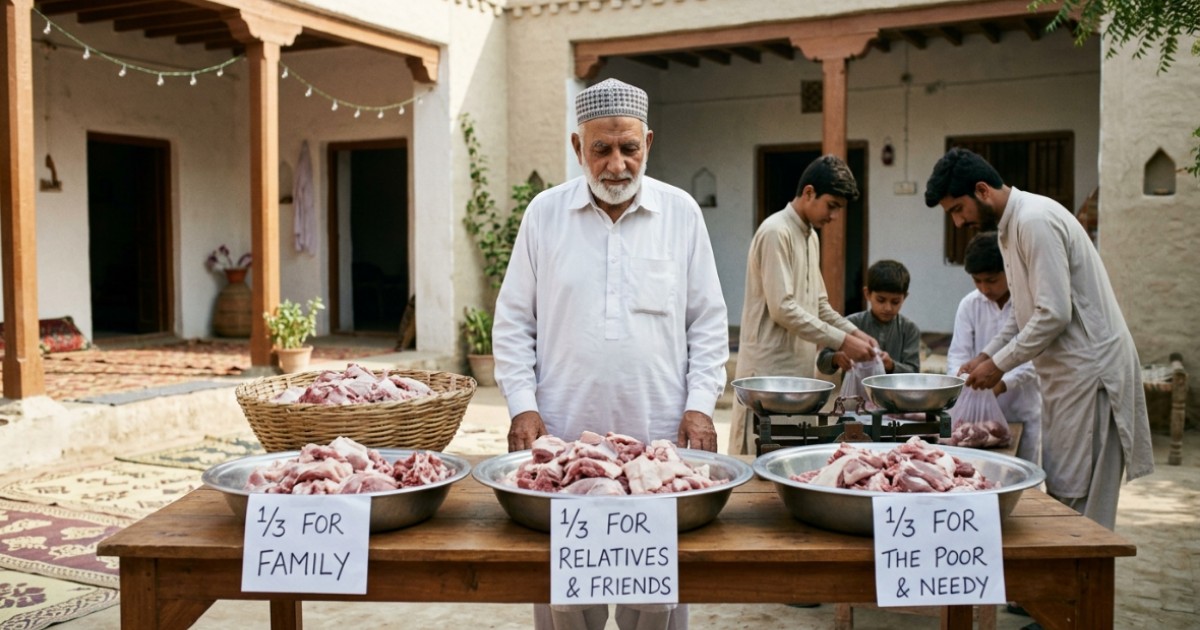
During the seasonal celebration of Eid Al Adha, questions frequently arise within Muslim communities regarding the proper management of sacrificial livestock distribution. A widespread cultural practice in South Asia encourages families to divide the total weight of the meat into three equal shares. According to this popular tradition, one portion is reserved for the immediate household, one for extended relatives, and the final share for impoverished citizens.However, Islamic legal experts have provided a nuanced structural clarification on whether this practice is mandatory.
Mufti Anisur Rahman Sikdar, a director at the Islamic Foundation, clarified that separating Qurbani meat into three portions is highly recommended but does not constitute an absolute obligation. If a household chooses to keep the entire portion due to a large family size or economic necessity, their religious sacrifice remains valid, and no spiritual sin is incurred. Similarly, individuals possess full theological freedom to donate the entirety of the meat to public welfare projects or shelters.
The core framework for distributing sacrificial meat is derived from traditional scripts within the Holy Quran. In Surah Al-Hajj, verse 28, the divine directive instructs believers to eat from the sacrifice and feed the distressed and the poor. Historical records indicate that Prophet Muhammad traditionally kept a third of the animal for his family, gifted a third to his neighbors, and distributed the rest to travelers, cementing the practice as an enduring community standard.
In many regional administrative sectors, a system known as `social distribution` is managed by neighborhood leaders to collect a mandatory fraction of meat for general distribution. Fiqh scholars emphasize that while collective charity is a positive social mechanism, forcing or pressuring families to surrender a specific weight of meat violates Islamic property ethics. Ultimately, according to Surah Al-Hajj, verse 37, neither the flesh nor the blood of the animal reaches God; rather, it is the internal piety and sincerity of the believer that validates the devotion.