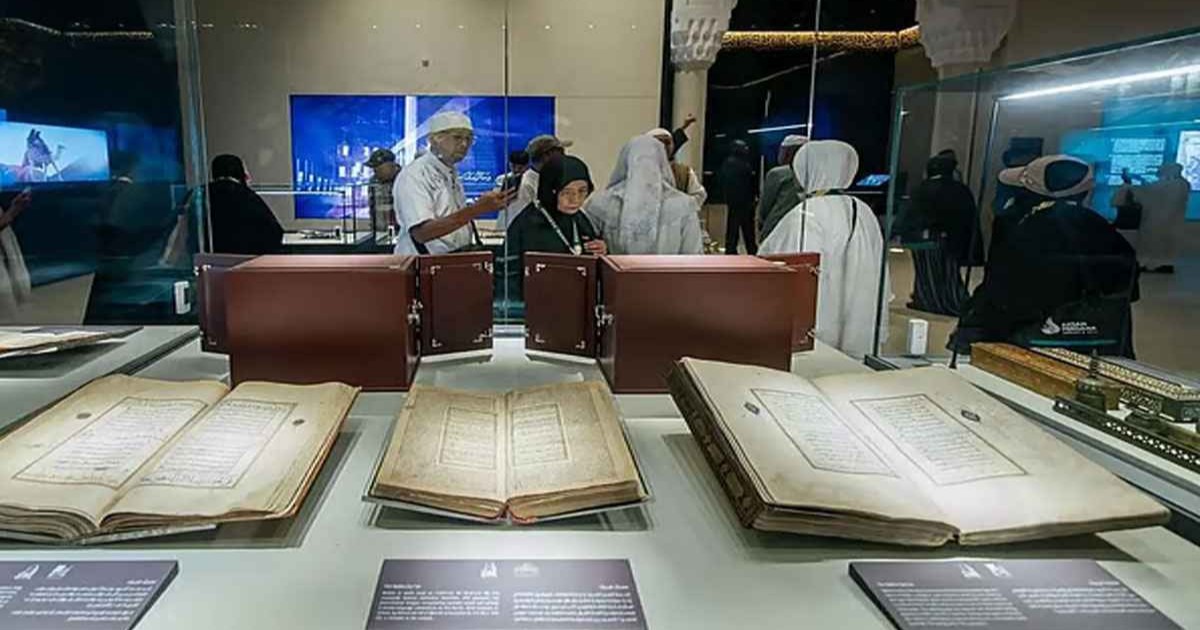
A rare 400-year-old Quran manuscript featuring intricate gold illumination was put on public display at the Holy Quran Museum in Mecca on Friday, the Saudi Press Agency confirmed. Located within the historic Hira Cultural District of the holy city, this unique artifact has quickly become a major attraction for international visitors and Islamic heritage enthusiasts. Historical experts date the sacred text back to the 11th Hijri century, which corresponds roughly to the early 17th century of the Common Era. The exquisite piece highlights the advanced craftsmanship and artistic sophistication achieved by Islamic calligraphers during that prosperous era of Islamic civilization.
The manuscript is particularly distinguished by its vibrant color palette and the extensive use of fine gold leaf throughout its pages. Administrative officials at the museum reported that the pages contain complex floral patterns and detailed geometric designs that reflect supreme dedication to the holy text. The opening leaf showcasing Surah Al-Fatihah displays an extraordinary combination of symmetry and golden borders that remains remarkably well-preserved. According to regional historians, such regal ornamentations were commissioned by prominent calligraphers to transform the transcription of the divine text into an enduring medium of visual art.
Operating under the direct supervision of the Hira Cultural District administration, the museum serves as a vital institution for chronicling the long evolution of Quranic scripts and traditional calligraphy. This exhibition is not merely a display of an ancient book but serves as an important educational center for understanding the development of medieval Islamic art. The preservation of this centuries-old manuscript underscores the deep reverence and spiritual love that global Muslim societies have continuously maintained for the holy Quran. Large crowds of pilgrims and cultural researchers from various countries are visiting the museum daily to witness the historic artifact.
The executive board of the museum emphasized that this rare specimen stands as a unique symbol of Islamic cultural wealth and artistic excellence. Technicians have placed the manuscript inside a highly controlled environment with specialized lighting and moisture regulation to prevent any deterioration of the gold work and fragile papers over time. What remains unclear is the exact geographical origin where the manuscript was transcribed and which royal collections housed it before its arrival in Mecca. However, international scholars are currently conducting extensive archival research to uncover these hidden historical details for future academic publications.
This exhibition in the holy city plays a significant role in promoting Islamic culture and educating younger generations about their rich historical past. The museum authorities have also revealed plans to launch local and international calligraphy competitions to keep the traditional methods of Quranic transcription alive. The unveiling of this magnificent text has renewed global interest in classical Islamic arts, providing an immense sense of pride for the global Muslim community. Art historians and scientific researchers alike have expressed deep admiration for the durability of the natural inks and the timeless brilliance of the gold decorations.