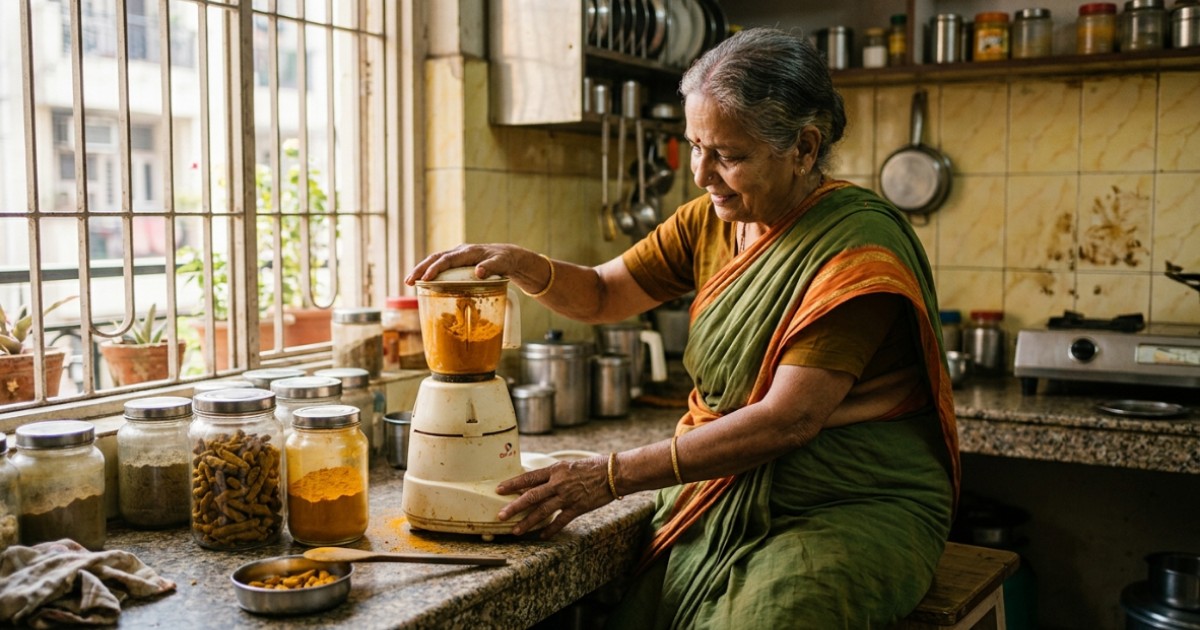
Fifty-five-year-old Nirmal Rao no longer buys packaged spices from the market in the Indian capital, Delhi. She spends her afternoons drying boiled turmeric in the sun before grinding it into a fine golden powder herself. Trust in commercial food items has completely eroded for many Indian consumers like her.
Rao is not an isolated case.
Middle-class households across Indian cities are quietly transforming their kitchens into miniature food-processing units. Families are making paneer at home and sourcing grains directly from local farms. This shift stems from deep-rooted distrust rather than culinary nostalgia. Government records show that roughly one in six food samples tested between 2022 and 2025 failed to meet safety standards.
More than 1,100 food business licenses were revoked during the same period.
Food safety officials in Hyderabad seized over 3,000 kilograms of adulterated tea powder last month. The mixture contained synthetic colors, jaggery juice, and expired tea leaves designed to boost visual appeal and profits. Experts point out that failed samples often involve severe contamination or deliberate adulteration, rather than simple hygiene or labeling violations.
Food adulteration has plagued the country for decades.
The nature of the fraud has evolved significantly over the years. Adulteration once meant diluted milk or tiny pebbles mixed into grain sacks. Recent raids regularly uncover milk spiked with chemical detergents and spices laced with toxic synthetic dyes.
India established the Food Safety and Standards Authority of India (FSSAI) under a 2006 law to combat these exact issues.
Former FSSAI chief Pawan Agarwal describes it as one of the most modern food safety frameworks globally. The law mandates licensing for everyone from massive food conglomerates to small street eateries. The reality on the ground tells a different story, as regulatory action mostly happens after a crisis occurs.
Most of the informal food economy operates outside the scope of preemptive product testing.
Saurabh Arora, managing director of food testing lab Auriga Research, highlighted a structural flaw in the enforcement system. Businesses only need to submit samples for testing once every six to twelve months. Unscrupulous operators routinely game this limited testing window by ensuring the specific submitted batch meets all standards, ignoring the rest.
Tracing unsafe products remains nearly impossible.
Countless unregistered shops and informal factories distribute unbranded loose items like oil, flour, and spices with zero paperwork. Tracking a contaminated batch in India can take weeks, whereas countries like the UK or Italy can recall products within hours. India’s National Human Rights Commission recently held a meeting addressing how contaminated goods spread widely before authorities can even identify them.
A severe shortage of manpower cripples enforcement efforts.
Fewer than 500 food safety officers are responsible for overseeing thousands of registered businesses in Maharashtra, one of India`s largest states. Food safety expert Sanjay Indani questioned how such a small workforce could possibly hold millions of informal operators accountable. Consumers are responding to this regulatory gap by simply paying a premium for peace of mind.
Many urban residents now opt for expensive brands or farm-to-home delivery services.
Twenty-nine-year-old Tiash De from Mumbai pays nearly 50 percent above market rates for milk delivery to guarantee its purity. Dr. Meenakshi Singh, chief scientist at the Council of Scientific and Industrial Research, projects the country`s organic food market will reach $10.81 billion by 2033. But medical professionals remain deeply concerned about the broader population exposed to substandard ingredients.
The true danger lies in food that does not cause immediate illness.
Dr. Rinkesh Kumar Bansal, chief of gastroenterology at a Fortis hospital, warned that repeated exposure to contaminated food silently damages the body over time. Patients may initially face simple digestive issues or fatigue. Long-term consumption actively contributes to liver damage, hormonal imbalances, and a higher risk of chronic diseases.
Social media has dramatically amplified public anxiety.
Information about food adulteration spreads instantly online, triggering immediate panic among consumers who view food safety as a deeply personal issue. Arora insists that regulations alone cannot solve a crisis driven by a mindset that ignores safety unless personal consumption is involved. The burden ultimately falls back on ordinary citizens like Nirmal Rao, who are left wondering what to do when even basic food cannot be trusted.