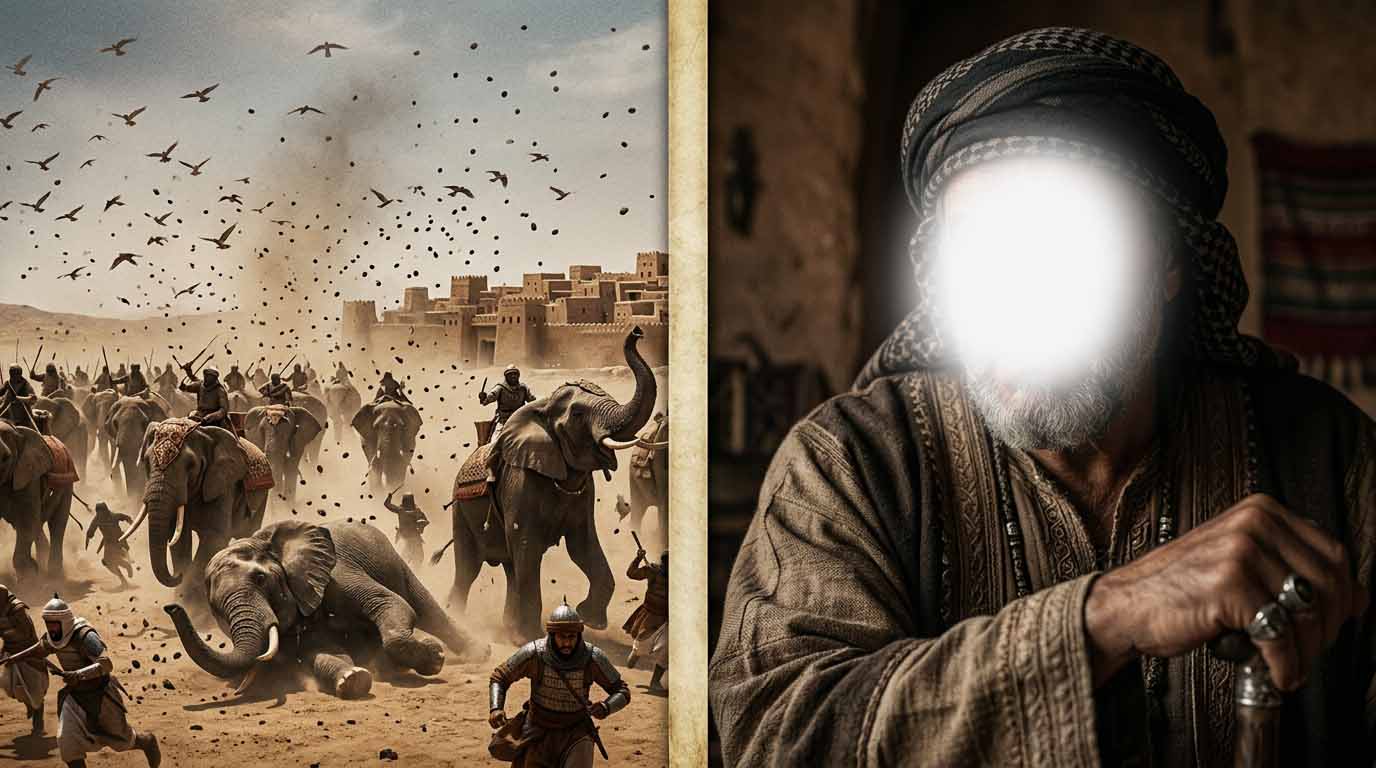
The historical resistance of Meccan leaders like Abu Jahl and Abu Lahab to the message of Islam was not merely a political or tribal conflict. Beneath the surface lay a complex psychological web, intertwined with a monumental event from their youth—the miraculous destruction of Abraha’s elephant army. Understanding why these influential figures remained steadfast in idolatry despite witnessing the truth requires a deep dive into the "Year of the Elephant" (570 AD) and its long-term mental impact on the Quraish elders. This psychological anchor served as a formidable barrier that kept their hearts closed to the light of Tawhid for over forty years.
According to Seerat Ibn Hisham, when Abraha al-Ashram invaded Makkah with his formidable elephant army to destroy the Kaaba, the Quraish stood no chance of defending themselves militarily. Abdul Muttalib, the Prophet`s (PBUH) grandfather, famously surrendered the situation to the Divine, stating that the House had its own Protector. The subsequent annihilation of the invaders by flocks of Ababil birds was an undeniable miracle. Abu Jahl and other elders were teenagers or young men at the time, and they witnessed this divine intervention firsthand. However, they misinterpreted the source of this protection, leading to a decades-long spiritual delusion.
At the time of Abraha’s defeat, the Kaaba was surrounded by 360 idols. In their limited understanding, the young Meccan leaders attributed the survival of Makkah not to the Unseen God, but to these idols. They believed their "gods" had saved them from a superpower. This created a deep-seated psychological bias, linking the presence of idols with national security and divine favor. For forty years, this belief was reinforced through rituals and oral traditions, making idolatry more than just a religion—it became an essential part of their identity and survival instinct.
In psychology, this phenomenon is known as "Experiential Bias" or "Anchoring." When Prophet Muhammad (PBUH) began his mission at the age of forty, preaching the futility of idols, Abu Jahl and his peers were trapped by their past memories. They reasoned that if the idols had "saved" the Kaaba from Abraha, they must be powerful. The message of Tawhid felt like a betrayal of the very forces they believed had protected them in their youth. This mental resistance was so strong that even the clearest logical proofs of Islam could not penetrate the thick layer of superstition hardened by forty years of misinterpretation.
In contrast, the early converts to Islam were predominantly young. Figures like Ali ibn Abi Talib (RA), Talha (RA), and Sa`d ibn Abi Waqqas (RA) were either unborn or too young during the Year of the Elephant to have formed such a rigid psychological bond with idolatry. Their minds were fertile and open to the logical and fitra-based message of Monotheism. For them, the idols were clearly powerless stones, and the message of the Prophet (PBUH) resonated with their innate common sense. The psychological gap between the elders and the youth was one of the defining features of early Islamic history in Makkah.
Abu Jahl’s ego and social status further complicated his psychological state. As a leader of the Makhzum clan, his identity was tied to his ancestral beliefs. Accepting Islam meant not only admitting that his lifelong beliefs were wrong but also submitting to the leadership of an orphan from the Banu Hashim. This combination of tribal pride and the lingering superstition from Abraha’s time blinded him to the truth. He chose to die in his ignorance during the Battle of Badr, never allowing himself to question the "reality" he thought he saw as a youth.
The psychological breakthrough for many of the surviving elders finally occurred during the Conquest of Makkah. As recorded in Sahih al-Bukhari, when the Prophet (PBUH) entered the Kaaba and smashed the 360 idols with his staff, a sense of dread filled the hearts of men like Abu Sufyan. They expected the heavens to fall or a curse to strike, still tethered to their childhood fears. When nothing happened—when the idols lay shattered and powerless—the psychological barrier finally crumbled. They realized that Abraha was defeated by Allah alone, and the idols were merely hollow symbols.
The mass conversion that followed the Conquest of Makkah, as mentioned in Surah An-Nasr, was the result of this massive psychological shift. The false wall of superstition had finally been demolished, revealing the plain truth that the Prophet (PBUH) had preached for twenty-three years. Those who lived to see this day were liberated from their misconceptions, while Abu Jahl serves as a cautionary tale of how experiential bias can lead one to eternal ruin. His story teaches us that true faith requires the courage to look past our childhood indoctrinations and embrace the truth of Divine Revelation.
Ultimately, this history serves as a profound lesson for modern society. Often, ancestral traditions or past experiences blind us to current truths. Abu Jahl’s life illustrates that clinging to "how things have always been" can prevent one from seeing "how things truly are." To recognize truth, one must be willing to open the doors of the heart and remove the glasses of superstition. Islam is built on logic, proof, and Divine Revelation, not on blind imitation. May Allah protect us from intellectual stubbornness and illuminate our hearts with the light of Tawhid.