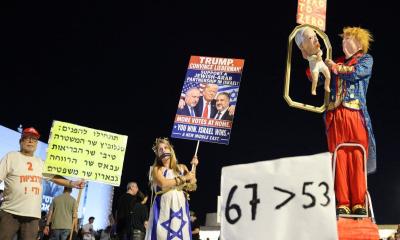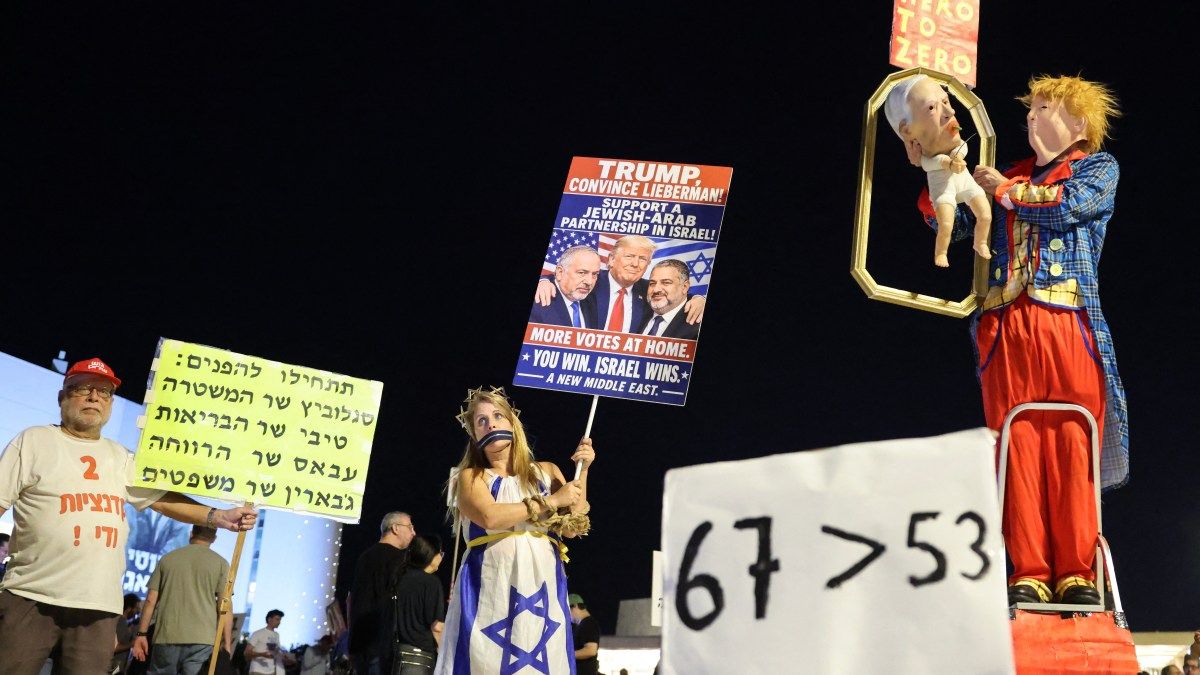
Thousands of demonstrators gathered on Habima Square in Tel Aviv on Saturday. They urged the Israeli opposition to forge a partnership with Arab parties to remove Prime Minister Benjamin Netanyahu from power.
Protesters participating in the weekend demonstration told journalists that this moment could be the final chance for genuine political transformation. They described Netanyahu, Israel’s longest-serving prime minister, as a master manipulator.
The rally followed a general election on Tuesday that ended in a parliamentary deadlock. Netanyahu and his political allies secured 53 seats in the 120-seat legislature, while the main opposition faction led by Gadi Eisenkot won 48 seats. Neither bloc holds enough seats to form a government independently.
Israel’s three Arab-led parties achieved major gains in the vote, capturing a combined total of 19 seats. Data from the Central Election Committee indicates that nearly 840,000 citizens cast ballots for Ra’am and the Joint List. This figure marks a 64 percent surge compared to the previous general election held in 2022.
Eisenkot has previously rejected the prospect of establishing a governing coalition with Arab factions. However, the current arithmetic means that an alliance with these parties would grant his bloc a secure majority of 67 seats in parliament. Political collaboration with Arab representatives remains controversial for many within the country.
Counter-protesters also gathered near the demonstration on Saturday. Supporters of the prime minister shouted slogans demanding that the nation avoid forming any government that includes figures they labelled as terrorists.
Right-wing political circles have condemned the high voter turnout among Palestinian Israelis. Critics have equated the electoral participation with the attack of October 7, when Hamas-led fighters entered southern Israel, resulting in more than 1,200 deaths and the capture of hundreds of hostages.
Palestinian-Israeli votes and voices face mounting attacks because they now hold a prominent position in determining whether Eisenkot can successfully assemble a ruling administration. Netanyahu has publicly alleged that Palestinian-Israeli parties manipulated the ballot and received financial support from Qatar to achieve their electoral gains.
The Qatari government has rejected these accusations entirely. Doha has characterised the claims made by the prime minister as a coordinated disinformation campaign.