Thousands of young Indians successfully forced the resignation of Union Education Minister Dharmendra Pradhan following massive protests in New Delhi over the 2026 NEET exam leak, signaling a profound shift in youth politics, according to an analysis by Al Jazeera. The sudden resignation of the powerful cabinet minister on July 25, 2026, marked a watershed moment in contemporary Indian politics. Indian politician and public policy commentator Sudhanshu Mittal noted in his detailed analysis that dismissing these demonstrations as merely another routine clash between the ruling government and the opposition fundamentally misses a much larger domestic and global narrative. The Cockroach Janta Party (CJP) protests revealed exactly how the country`s youngest generation completely reimagines politics, state institutions, and the basic social contract.
At the very core of this massive social upheaval was the devastating scandal surrounding the National Eligibility-cum-Entrance Test (NEET), the highly competitive nationwide examination for undergraduate medical courses. When shocking allegations of a widespread paper leak and severe irregularities in the grading process first surfaced, the immediate reaction was intense and justifiable anger among the candidates. The outrage, however, rapidly transcended the specifically affected students. The monumental scandal struck directly at the heart of the Indian middle-class dream, severely eroding the deeply held cultural belief that formal education and strict meritocracy remain the most reliable pathways to economic opportunity and social mobility.
Millions of households across the developing nation routinely invest their entire life savings and organize their entire family existence around the fragile promise of these high-stakes examinations. When the basic integrity of that massive system completely collapsed, it ignited a profound collective anxiety across the country. Students and parents alike began to fear that exhausting hard work and pure academic excellence were no longer sufficient for success in an increasingly compromised system. As Mittal explained, this specific institutional failure acted as the perfect catalyst, transforming simmering public anxiety into a highly organized and uncompromising political movement.
The specific origin and subsequent political transformation of this movement were entirely unconventional. In May 2026, during a high-profile Supreme Court hearing, the Chief Justice of India, Surya Kant, made a highly controversial remark comparing unemployed youth and vocal social media activists to "cockroaches" and "parasites." In direct response to this perceived judicial condescension, digital communications strategist Abhijeet Dipke officially founded the Cockroach Janta Party on May 16. According to international media reports, what initially began as a purely satirical digital response rapidly transformed into a formidable physical political force. By actively embracing the grave insult as a proud badge of honor, the nascent movement resonated instantly with millions of heavily frustrated young citizens.
The founding leadership team, which included Saurav Das, Ashutosh Ranka, and official spokesperson Ratna Singh, primarily consisted of university graduates with extensive backgrounds in digital communication, law, and social mobilizing. Within merely a few days of its chaotic inception, the CJP`s official Instagram follower count exploded, rapidly surpassing 22 million. This staggering digital reach effectively dwarfed the online presence of deeply established political entities, including the heavily funded ruling Bharatiya Janata Party. This unprecedented online growth was fundamentally fueled by grim macroeconomic realities. With the unemployment rate among degree-holders aged 15 to 25 reaching an alarming 40 percent, the youth felt entirely abandoned by the state apparatus.
The digital movement quickly transitioned into an unstoppable physical mobilization. Beginning in early June, regular sit-ins were organized at Jantar Mantar in New Delhi, supported heavily by various left-wing student organizations including the All India Students Federation and the Students` Federation of India. The widespread agitation drew massive national attention when prominent climate and education activist Sonam Wangchuk began an indefinite hunger strike at the protest site on June 28. CJP representatives actively engaged with government officials, meeting Union Health Minister J.P. Nadda to present their uncompromising demands. These included sweeping administrative reforms, the immediate resignation of the education minister, and financial compensation of 10 million rupees for the grieving families of students who tragically died by suicide due to the intense examination turmoil.
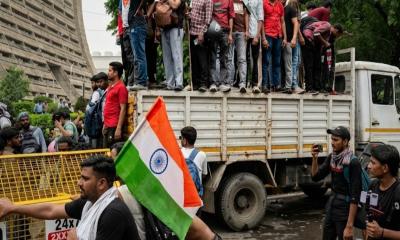
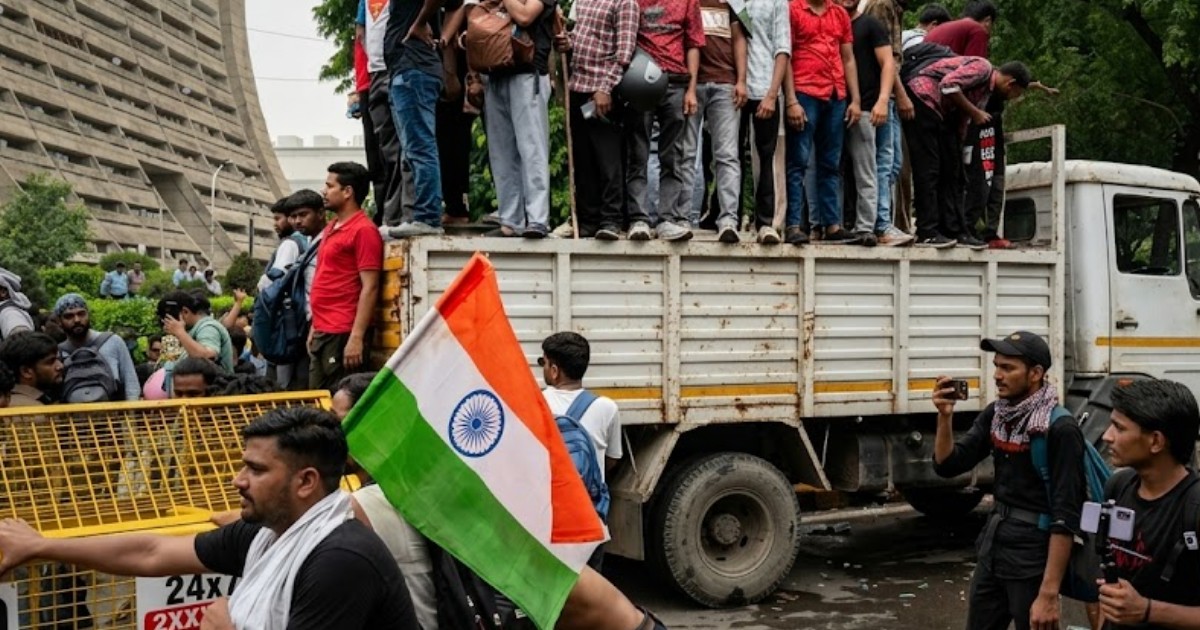
The peaceful demonstrations escalated dramatically on July 20, 2026, during the heavily publicized "Sansad Chalo" march. Tens of thousands of young protesters deliberately defied strict police orders and attempted to march directly toward the Parliament House in the capital. The state security response was immediate and severe. Police forces deployed heavy tear gas and conducted aggressive baton charges to disperse the massive crowds, leading to violent and chaotic clashes across the city center. Multiple hospitals, including the Ram Manohar Lohia Hospital, recorded dozens of severe medico-legal cases involving both injured student protesters and battered police personnel.
In one particularly shocking incident heavily covered by Al Jazeera, an Indian police officer was immediately suspended after inexplicably firing an AK-47 assault rifle during the tense student protests. The heavy-handed state crackdown completely failed to suppress the organic movement; instead, it successfully garnered massive global solidarity. Prominent climate activist Greta Thunberg notably joined a large rally in London in direct support of the CJP-led student movement, proving that the deep grievances of Indian youth struck a powerful chord internationally.
Faced with mounting domestic paralysis and a severe public relations disaster, the Indian government was eventually forced to concede to the pressure. Dharmendra Pradhan officially stepped down from his powerful cabinet post on July 25, and Pralhad Joshi was swiftly appointed as the new education minister to calm the situation. Prime Minister Narendra Modi later addressed the tense political environment, publicly stating that he forgave the angry students who had aggressively targeted him. He specifically characterized the protesters as misled children who urgently needed to be shown the right path, a statement that drew mixed reactions from the youth organizers.
The government also moved quickly on the legislative front, introducing tough new laws designed to significantly increase the legal penalties for anyone involved in public examination leaks. However, Mittal argues that the grand political theater surrounding the government`s panicked response threatens to overshadow the genuine underlying crisis of institutional trust. The CJP protests reflect a much broader, global pattern of Generation Z fundamentally reshaping traditional democratic politics. From the massive anti-extradition movement in Hong Kong and the Yellow Vest protests in France to the recent student mobilizations in Bangladesh and Chile, youth-led movements are increasingly driven by practical demands for fairness, transparency, and economic opportunity rather than strict traditional ideological loyalties.
What remains unclear is exactly how quickly established governments will adapt to this new structural reality. These new political actors are highly digitally connected, deeply skeptical of established institutions, and fiercely independent. They sternly demand that the administrative systems entrusted with safeguarding merit must not only operate fairly in private but must be transparently seen to do so in public. The CJP protests initially began with a highly legitimate anxiety over a single medical examination but rapidly evolved into a comprehensive, national critique of governance and institutional legitimacy. While the specific Cockroach Janta Party may eventually fade from the daily headlines, the profound political awakening it successfully represents will undoubtedly shape the future trajectory of Indian democracy for the coming decade.