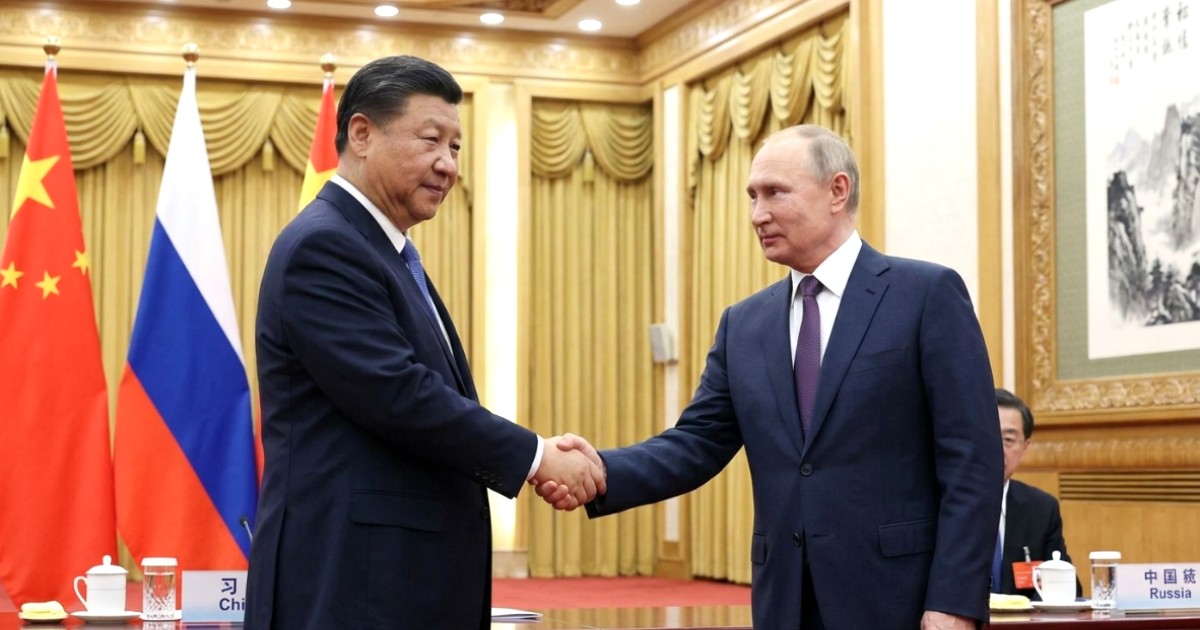
Russian President Vladimir Putin is scheduled to arrive in Beijing this week to commemorate the twenty-fifth anniversary of the treaty on good-neighborliness and friendly cooperation between the two nuclear-armed states. Amidst compounding Western economic isolation and systematic diplomatic sanctions, the neighboring giants have consistently broadcasted their relationship to international observers as a "no limits" partnership. An unscripted microphone capture during an informal walk across Tiananmen Square last year—detailing philosophical views on organ transplants and human longevity—revealed a rare personal baseline underpinning this strategic execution.
However, beneath the public display of ideological unity lies a profoundly asymmetric economic reality.
Data compiled by the Carnegie Russia Eurasia Center indicates that the contemporary distribution of diplomatic leverage remains heavily skewed in favor of Beijing`s domestic interests. While China functions as Russia`s single largest external mercantile partner, the Russian market accounts for a mere four percent of the East Asian superpower`s comprehensive global trade ledger. Following the escalation of the conflict in Ukraine, the Kremlin has been forced to dramatically realign its economic dependencies, extracting over ninety percent of its prohibited technological components directly from Chinese production networks. Consequently, corporate tech giants like Huawei have seamlessly transformed into the foundational backbone of Russia`s national telecommunications infrastructure.
Moscow`s administrative elite remains structurally cognizant of the strategic vulnerabilities linked to this degree of economic subordination, repeatedly asserting their status as an independent global power block. Russia`s primary defense against total diplomatic absorption remains its historical capacity to maintain an unyielding position on core sovereign issues. A definitive manifestation of this independence materialized in 2023, when short intervals after receiving private advisories from Xi Jinping regarding nuclear non-proliferation, the Kremlin unilaterally announced the forward deployment of tactical nuclear hardware into Belarus. For Beijing, maintaining a stable partner in Moscow guarantees a permanent supply of heavy military components and operational testing environments, which remain crucial assets as planners evaluate strategic options regarding Taiwan.
Concurrently, prolonged maritime security vulnerabilities across corridors like the Strait of Hormuz have elevated Russia’s vast Siberian resource reserves into a critical pillar of Chinese internal energy security. Negotiations for the long-delayed `Power of Siberia 2` pipeline have advanced into preliminary contractual frameworks, aiming to channel fifty billion cubic meters of natural gas annually via Mongolia into industrial sectors. Despite this deep industrial integration, structural analysts emphasize that the framework functions as a flexible strategic partnership rather than a rigid mutual defense pact. This operational elasticity allows both administrations to consistently insulate each other from international human rights scrutinies while aligning voting alignments across United Nations councils.
Although executive interactions reflect absolute institutional proximity, the historical cultural integration between the two societies remains limited. Historically, affluent Russian circles systematically preferred shifting capital reserves toward premium real estate markets in Western Europe, yet contemporary visa restrictions are actively redirecting these human flows eastward. The enforcement of reciprocal visa-free transit configurations, coupled with integrated digital payment gateways, has generated a rapid proliferation of Chinese vehicular and cellular hardware across municipal centers. While the balance of systemic capabilities shifts toward Beijing, both states operate under the shared realization that maintaining the current eurasian axis remains vital to counter modern Western containment frameworks.