Football is preparing for a significant legislative shift to address one of the sport`s most persistent and frustrating loopholes: the "tactical timeout" disguised as a goalkeeper injury. For years, teams under pressure have utilized a specific tactic where their goalkeeper goes to ground, forcing the referee to stop play for medical attention. Because a match cannot proceed without a goalkeeper, this creates a risk-free window for coaches to deliver instructions to their outfield players at the touchline.
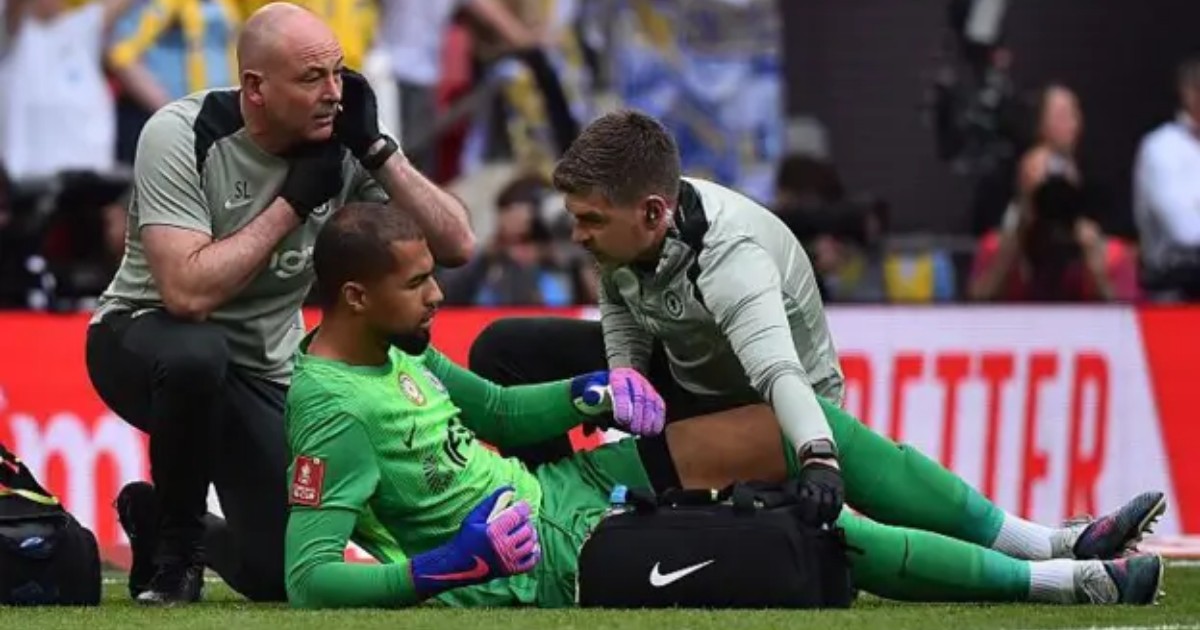
The issue reached a boiling point during the recent FA Cup semi-final between Chelsea and Leeds United. Chelsea goalkeeper Robert Sanchez sat down on the Wembley turf, prompting a stoppage that allowed the London side`s outfield players to sprint to the technical area for coaching. The Leeds faithful responded with a chorus of boos, reflecting a global exhaustion with the tactic. According to reports from BBC and Reuters, the International Football Association Board (IFAB) has acknowledged that current laws leave referees powerless, as they cannot ethically accuse a player of feigning an injury.
To break this cycle, IFAB has proposed four distinct trials to be offered to professional leagues for the 2026-27 season. The Women`s Super League in England has already expressed interest in participating in these tests. The objective is to remove the incentive for these manufactured stoppages.
The first trial involves a mandatory "sin-bin" style punishment for the team. If a goalkeeper requires treatment on the pitch, one outfield player from that team must leave the field for one minute. This forces the coach to weigh the benefit of a tactical talk against the disadvantage of playing with 10 men. The second trial doubles this penalty to two minutes, aiming to provide an even stronger deterrent for managers who might otherwise calculate the one-minute absence as an acceptable risk.
The third proposal, currently being pioneered by the National Women`s Soccer League (NWSL) in the United States, focuses on the behavior of the remaining players. Under this rule, if a goalkeeper is injured, outfield players are strictly forbidden from approaching the technical area. They must either remain in their positions or gather near the center circle. Any breach results in disciplinary action against the team or the coach. The fourth and final option is a "hybrid model" that combines the one-minute player removal with the ban on touchline gatherings.
Football analysts note that while these rules target goalkeepers, the underlying issue is the manipulation of the spirit of the game. Previous attempts to curb time-wasting, such as the 30-second rule for outfield players, only shifted the burden of "acting" to the goalkeepers. Daniel Farke, the Leeds United manager, recently criticized Manchester City’s Gianluigi Donnarumma for similar antics, labeling it a "bending of the rules." As IFAB prepares to analyze the data from these trials in March 2027, the era of the "miraculous recovery" immediately following a coaching huddle may finally be coming to an end.