Charging cables are perhaps the most overlooked pieces of technology in our lives—until they stop working and leave us with a dead smartphone. According to experts, we are often the reason these essential tools keep failing. Michael Pecht, founder of the Center for Advanced Life Cycle Engineering at the University of Maryland, has spent decades studying why electronics break. His team subjects cables to "unspeakable horrors," including smashing and stretching, only to study the resulting damage under X-rays. His conclusion is surprising: the way we wrap our cables doesn`t matter nearly as much as we think; it’s our daily usage habits that are the real killers.
For years, many of us believed that wrapping cables in tight circles was a shortcut to ruined wires. However, Pecht’s research shows that most failures don`t happen in the middle of the coil but rather at the "joint"—the point where the flexible cable meets the rigid connector plug. Kyle Wiens, co-founder of iFixit, notes that cables almost always fail at this specific junction because that is where all the physical stress accumulates. When you pull the cable at a sharp angle while using your phone in bed, you are essentially asking for trouble.
The science behind this is fascinating yet simple. Inside every cable are tiny metal wires. When you bend these wires repeatedly at the same point, you cause an accumulation of defects called "dislocations" at an atomic level. Robert Hyers, an engineering expert at Worcester Polytechnic Institute, explains that bending metal beyond its elastic range causes bonds between atoms to break and reform incorrectly. Much like a paper clip that snaps after being bent back and forth, the microscopic wires inside your charger eventually harden and snap due to this accumulated stress.
Some of the worst habits identified by experts include pulling on the long cord instead of the plastic plug to disconnect it, using cables that are too short to comfortably reach a socket, and propping up a charging phone in a car cup holder. In the latter case, the entire weight of the phone rests on the connector joint, exacerbated by the vibrations and bounces of driving. These actions are "cruel" to the hardware and significantly shorten its lifespan.
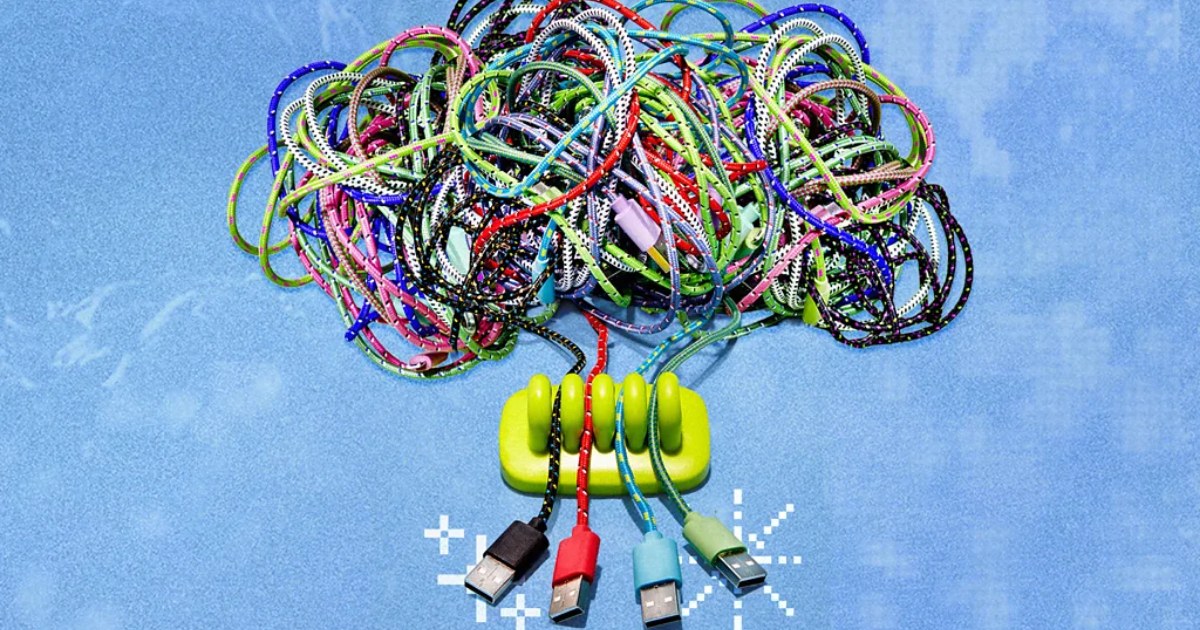
To prevent frequent replacements, experts recommend investing in high-quality, "braided" cables. These use nylon mesh or textiles woven over the wires, providing much better shielding and strength than standard plastic exteriors. Even major tech giants like Apple have shifted toward braided designs for their durability. While cables may seem like minor accessories, treating them with a little respect—by pulling only from the plug and avoiding sharp bends—is better for both your wallet and the environment. By understanding the microscopic fragility of these wires, we can ensure our technology stays powered up for years to come.