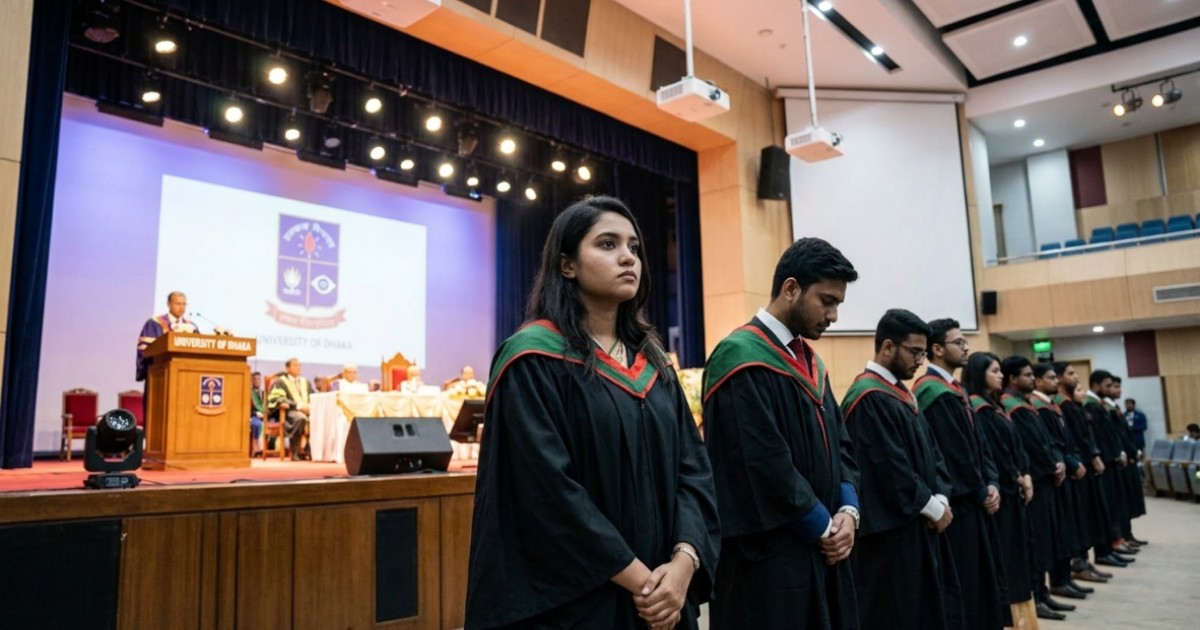
The former Finance Adviser of the interim government, Dr. Salehuddin Ahmed, stated that the country’s economy was in a deep structural crisis when the administration assumed office. Speaking at the 58th convocation of the Institute of Business Administration (IBA) of Dhaka University, he noted that limited administrative power and the absence of a political mandate hindered the execution of several critical initiatives. Consequently, the temporary administration had to focus primarily on managing a collapsed system rather than initiating sweeping structural overhauls. The convocation ceremony took place on Friday afternoon at the Bangladesh-China Friendship Conference Center in Dhaka.
Many individuals expect immediate changes, but the reality remains that deep-seated economic crises cannot be resolved overnight.
The former adviser explained that although visible alterations were not instantly apparent across all sectors, foundational stabilization steps were achieved in the economy and civil administration. He described his operational strategy using two distinct concepts: initial "repair" followed by targeted "reform." When the interim regime took charge, widespread instability plagued the banking sector, capital markets, and national revenue administration. Foreign exchange reserves had plummeted significantly, and the balance of payments was severely negative, though these specific indicators have since reached a degree of market equilibrium.
Addressing the fragile banking sector, Dr. Ahmed emphasized that long-standing irregularities, political influence, and weak legislative frameworks have complicated recovery efforts. Legal frameworks must be thoroughly overhauled because administrative directives alone cannot yield positive outcomes under structurally flawed laws. He added that while recovering laundered assets from foreign jurisdictions remains a challenging task, modern financial technologies and international judicial cooperation now offer faster avenues for asset recovery. Furthermore, he criticized the lack of corporate governance in both public and private sectors, pointing out massive inefficiencies where brief infrastructure projects drag on for decades.
The former adviser also expressed serious concern regarding the national energy strategy and export diversification. He highlighted that Bangladesh neglected new gas exploration for a prolonged period while neighboring countries advanced, leading to reduced productivity across domestic industrial zones. Despite receiving various state-backed fiscal incentives for years as protected "infant industries," many export sectors have failed to establish global competitiveness. Dr. Ahmed urged the graduating business students to pursue efficiency and transparency to help the nation navigate external headwinds, including changing United States trade policies and shifting international tariff environments.
Dhaka University Vice-Chancellor Professor A B M Obaidul Islam attended the event as the chief guest, urging the new graduates to provide ethical and humane leadership. He emphasized the critical importance of continuous learning in the era of artificial intelligence and automated technological disruptions. Chaired by IBA Director Professor Abu Yousuf Md. Abdullah, the ceremony officially conferred degrees upon 365 students across BBA, MBA, Executive MBA, and DBA programs, recognizing 26 students on the Director’s Honor List.