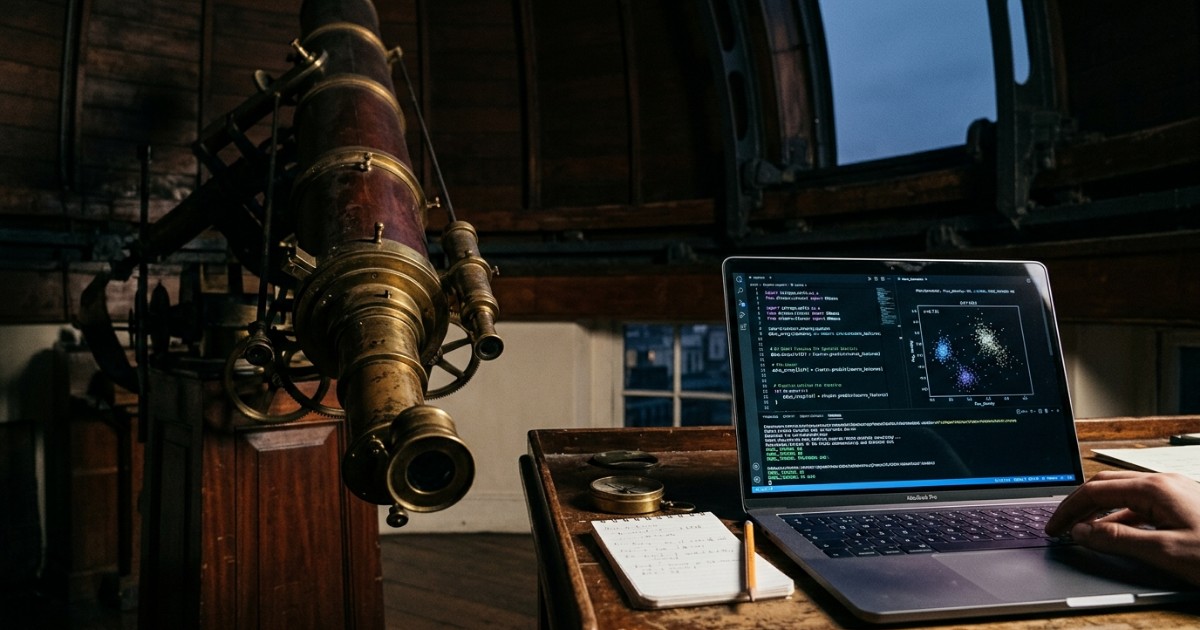
The Royal Observatory Greenwich has issued a stark warning regarding the rapid rise of artificial intelligence, stating that tools providing instant answers could systematically decline human intelligence. One of the United Kingdom`s oldest purpose-built scientific institutions, famous for its foundational contributions to global astronomy, raised alarms over society`s growing dependence on automated systems. Paddy Rodgers, the director of the Royal Museums Greenwich group, emphasized that the rich history of scientific research demonstrates the irreplaceable power of human curiosity.
A complete reliance on instant answers poses severe long-term risks.
Rodgers noted that outsourcing cognitive efforts to machines threatens to eliminate the essential habits of questioning and evaluation that underpin genuine expertise and innovation. His remarks coincided with the ongoing transformation of the historical site under a specialized development project called First Light. This framework aims to interpret the raw passion of astronomers over the past 350 years through modern scientific communication. While acknowledging that technological innovation has always driven major scientific breakthroughs, Rodgers highlighted that progress fundamentally relies on humans pursuing answers to unexpected variables.
Early astronomers meticulously compiled massive astronomical datasets without automated assistance.
Their extensive documentation laid the groundwork for scientific applications that the original researchers could have never anticipated. Rodgers told the BBC that humans frequently perform seemingly unnecessary analytical tasks that a machine would simply bypass. Generations later, those hand-written archives became an invaluable resource used 150 years after their creation to verify theories regarding global maritime navigation. This long-term cognitive utility highlights a depth of human intellect that automated systems cannot easily replicate.
Conversely, artificial intelligence has played a prominent role in accelerating contemporary discoveries.
In 2024, computer scientist Sir Demis Hassabis shared the Nobel Prize in Chemistry for his revolutionary work on predicting protein structures. As the chief executive of Google`s AI division, DeepMind, Hassabis created a highly advanced tool called AlphaFold2 to map the building blocks of life. Additionally, LinkedIn co-founder Reid Hoffman described AI as a transformative agent for cognitive excellence, suggesting users deploy the technology as a counter-agent to rigorously challenge and stress-test their own strategic ideas.
Educational professionals have similarly observed the dual nature of generative technology within academic frameworks. An Oxford Brookes University lecturer noted that when utilized responsibly, AI tools enable students to direct focus toward deeper developmental aspects of learning. However, academics warn that completely outsourcing critical thinking to automated chatbots highlights the stark limitations of the technology. As generative models continue to advance rapidly in generating photorealistic content and complex text, the preservation of original human thought remains a vital global challenge.