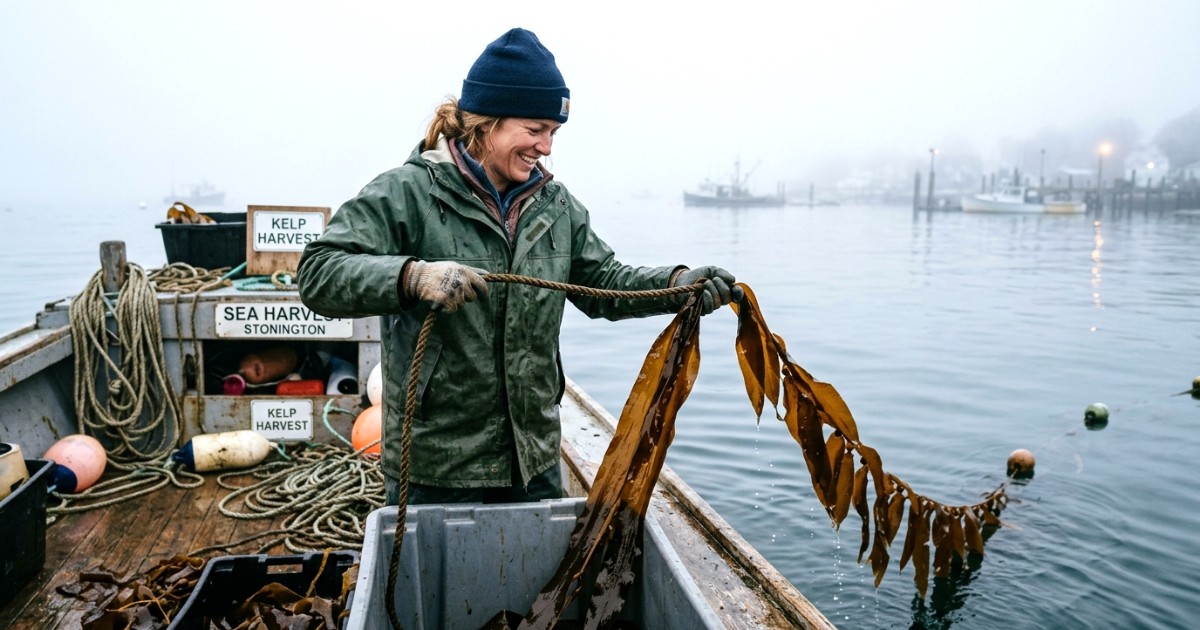
A former corporate professional has successfully walked away from a desk career in Manhattan to establish a commercial sugar kelp farm off the coast of New England. Suzie Flores now navigates the winter waters of Stonington, Connecticut, working to introduce domestic consumers to sustainable aquaculture grown directly beneath the ocean waves. Her specialized enterprise, the Stonington Kelp Company, reflects a growing movement aimed at utilizing regional maritime resources to diversify Western culinary markets.
The transition from academic publishing to open-ocean cultivation required reshaping local dietary expectations regarding marine vegetables.
Flores chose to abandon her urban lifestyle following a period of deep family reflection alongside her husband, Jay, a former military combat photographer who returned from overseas tours seeking structural renewal. The couple acquired a run-down commercial marina situated on the state border between Connecticut and Rhode Island to anchor their transition into marine environmental science. With assistance from university biologists and non-profit ocean cultivation groups like GreenWave, Flores mastered the complex regional permitting processes required to seed marine lines. However, the initial harvest brought an unexpected structural challenge, as a viable commercial market for raw seaweed did not yet exist domestically.
To generate sustainable demand, Flores initiated direct outreach to regional farm-to-table restaurants, introducing local chefs to the delicate, briny flavor profile of East Coast sugar kelp. While general consumers frequently mistake native seaweed for the tougher Pacific varieties like Japanese kombu, local sugar kelp offers a lighter, crisp texture that pairs easily with traditional cuisine. The persistent direct-to-chef marketing campaign proved effective, and the agricultural operation now completely sells out its inventory every season. High-end kitchens prize the marine crop because it provides a reliable local source of fresh green produce weeks before land-based farms yield crops.
David Standridge, the executive chef at The Shipwright`s Daughter in Mystic—a prominent 2026 James Beard award finalist—remains a core wholesale client of the maritime farm. Standridge stated that the sugar kelp serves as an exceptional seasonal asset because it introduces a crisp, light brininess to standard dishes without overwhelming parallel flavor components. More importantly, the chef noted that the kelp absorbs the specific environmental characteristics of the local water column, providing an authentic ocean terroir directly on the plate. This subtle ecological signature has made the crop highly attractive to sustainable dining establishments seeking transparent supply chains.
The broader expansion of the domestic seaweed sector continues to face significant infrastructural hurdles, as the United States currently imports over ninety percent of its commercial seaweed supply from historical production hubs in Asia. Local processing networks, distribution loops, and consumer scaling mechanisms remain undeveloped compared to established international systems. Furthermore, ocean cultivation carries severe immediate risks, with recent winter storms bringing seventy-mile-per-hour winds that destroyed close to half of Flores’ structural deep-water lines. Despite these seasonal setbacks, the ecological benefits of kelp farming—which includes active nitrogen pollution reduction and habitat creation for marine biodiversity—continue to drive the small family-operated network forward as a viable replacement for collapsing local lobster fisheries.