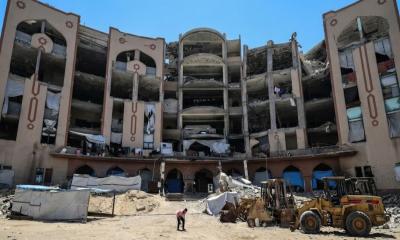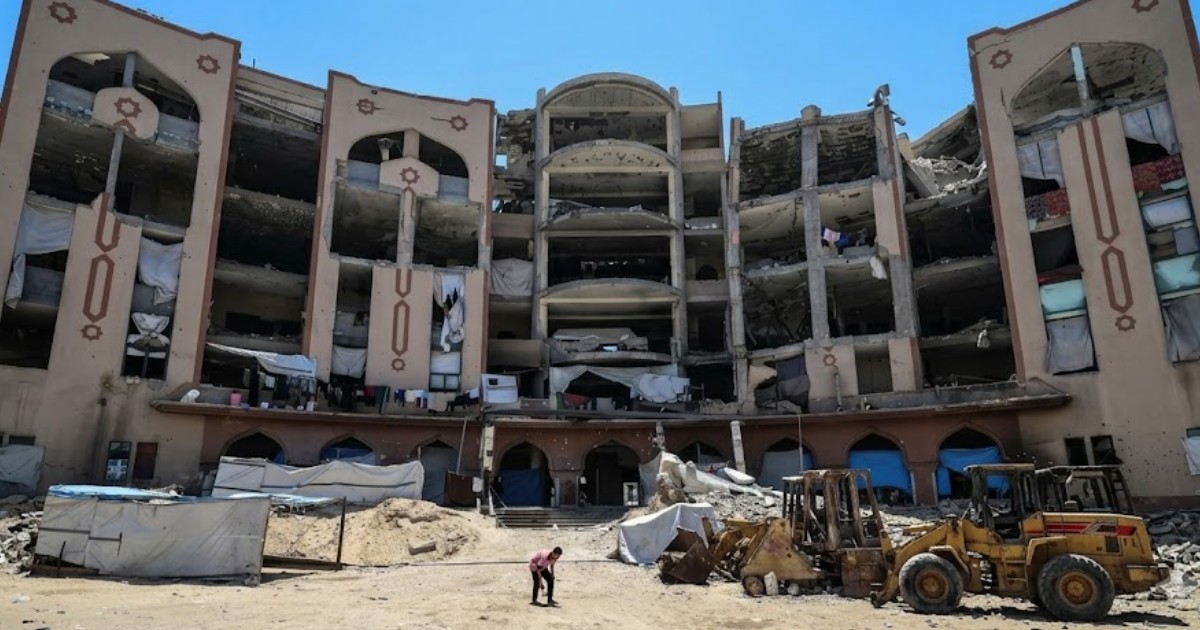
Despite sustaining catastrophic infrastructure damage from continuous Israeli military strikes, the faculty, staff, and students of the Islamic University of Gaza are actively working to restore higher education across the enclave, according to reports verified by Al Jazeera and UNESCO. Prior to the onset of military operations in October 2023, the institution operated as one of the premier public research universities in the Palestinian territory. It was particularly renowned for its advanced programs in medicine, health sciences, and engineering, maintaining modern laboratories equipped with specialized diagnostic instruments and anatomical models designed to prepare students for technical careers.
The ongoing military campaign severely compromised the university`s operational framework. Assessments conducted by the Palestinian Ministry of Education and Higher Education in coordination with UNESCO reveal that at least 19 major academic buildings were completely destroyed. Furthermore, approximately 500 classrooms, 200 scientific research laboratories, and 75 computer facilities suffered extensive structural destruction. The central university library experienced the loss of more than 240,000 reference books, academic journals, and historical theses. Professor Abdulraouf Ali al-Manama, Dean of the Faculty of Health Sciences, characterized the destruction as the most profound disaster in the university`s five-decade history, noting that years of accumulated scientific equipment were reduced to rubble.
The displacement of local populations further complicated academic recovery, as remaining university facilities were converted into temporary shelters for homeless families. Recurring electricity blackouts, total internet outages, severe transportation hazards, and psychological trauma have presented immense obstacles to standard instruction. Because specialized diagnostic laboratories and physical apparatus were destroyed, faculty members were forced to transition practical coursework into theoretical lectures. Fields that rely fundamentally on hands-on clinical training, such as microbiology, biochemistry, and physical therapy, lost the physical environments necessary to teach technical proficiency to upcoming medical cohorts.
To bridge the gap caused by destroyed infrastructure, the administration implemented temporary alternative learning methodologies. Professors began utilizing digital simulations, pre-recorded laboratory experiments, and restructured academic schedules delivered online. Concurrently, medical students were integrated directly into overburdened public hospitals, emergency departments, and surgical units across northern and southern Gaza to gain real-world clinical experience. Medical student Deema Muhaisen described receiving lectures in crowded hospital corridors and assisting physicians in operating rooms. While such field volunteer work provided intense practical exposure, academic leaders emphasize that informal hospital environments cannot fully replace structured laboratory instruction under direct academic supervision.
Recognizing the immense difficulty students face when traveling across divided zones, the university established five regional education centers in different parts of the Gaza Strip. These decentralized hubs allow students to attend small-group sessions and access resource materials closer to their temporary residences without navigating high-risk transit routes. University laboratory coordinator Yassin al-Nounou explained that these local branches help alleviate student anxiety regarding the transition from theoretical study to professional practice, offering a structured environment despite the main campus remaining largely unusable.
Complete institutional recovery remains constrained by external economic and political factors. Rebuilding the academic framework requires not only physical reconstruction of destroyed facilities but also the importation of specialized scientific instruments, including microscopes, incubators, sterilization units, spectrophotometers, and specialized computing hardware. However, the ongoing siege and strict border controls severely restrict the entry of construction materials and laboratory equipment into the territory. Consequently, comprehensive reconstruction plans remain largely theoretical, pending international financial aid and authorized access for technical equipment.
What remains unclear is how long the institution can maintain these temporary hybrid measures if border restrictions continue to prevent the importation of essential scientific instruments. Despite these systemic limitations, the leadership of the Islamic University of Gaza maintains its core mission of providing higher education to the local population. Academic leaders stress that investing in human capital through education is indispensable for the long-term social and economic recovery of Gaza. The collective determination of students and faculty underscores a broader effort to preserve professional capacity and ensure that future generations of doctors, engineers, and scholars are equipped to rebuild their society.