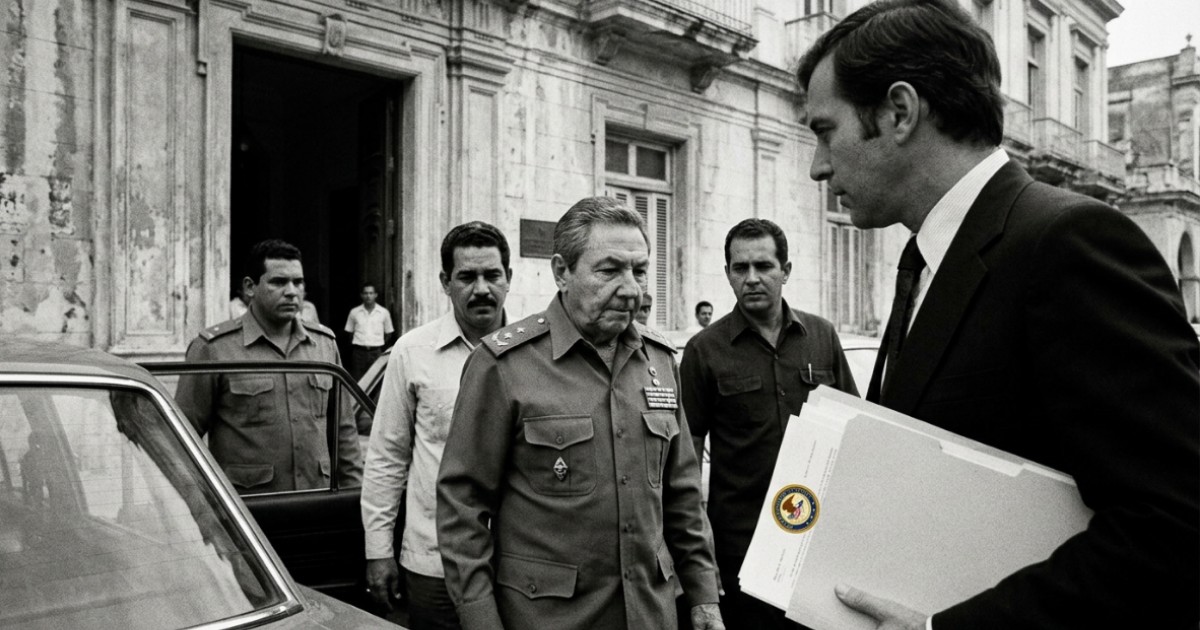
The United States has formally charged former Cuban leader Raúl Castro with murder and conspiracy over the 1996 downing of two civilian aircraft. Acting Attorney General Todd Blanche announced the indictment Wednesday at Miami’s Freedom Tower. The historical crash killed four members of the Cuban-American group Brothers to the Rescue, including three American citizens.
An active arrest warrant has also been issued.
Castro, now 94, commanded Cuba’s armed forces at the time. The specific charges include the destruction of aircraft and four individual counts of murder for the deaths of Armando Alejandre Jr, Carlos Alberto Costa, Mario Manuel de la Peña, and Pablo Morales. Blanche emphasized that the US government is officially pursuing accountability for the decades-old incident.
The Justice Department says convictions could carry life imprisonment or the maximum penalty of death.
The prospect of Castro appearing in a US courtroom remains highly unclear. Blanche did not specify whether a physical capture operation was planned but stated expectations that Castro would arrive by his own will or another way. Former federal prosecutor Lindsey Lazopoulos Friedman told the BBC that if Castro were to appear, he would receive standard legal rights, including a trial by jury.
Havana immediately dismissed the aggressive legal move.
Cuban President Miguel Díaz-Canel condemned the charges as a baseless political maneuver designed to justify future military aggression. He maintained that Cuban forces acted in legitimate self-defense within their own jurisdictional waters during the 1996 incident. State media outlets on the island echoed the sentiment, categorically rejecting the indictment as false.
The legal action aligns with mounting US economic and political pressure on Cuba’s communist leadership.
Sanctions and an active blockade on oil shipments have triggered severe blackouts and widespread food shortages across the island. Secretary of State Marco Rubio timed a public message to coincide with Cuban independence day, offering a new path under the Trump administration. Rubio directly blamed the military-run conglomerate GAESA, which controls major economic sectors from ports to luxury hotels, for the ongoing domestic hardships.
President Donald Trump highlighted the humanitarian angle, citing his long-standing relationship with Cuban-Americans.
The announcement drew immediate praise from the Cuban exile community gathered in Miami. Attendees surrounded by photographs of the victims described the indictment as long-overdue justice. Isela Fiterre called it a reckoning for a regime she accused of countless killings over several decades.
Mercedes Puid-Soto added that the legal step helps victims` families finally close a painful chapter.
The strategy closely mirrors recent US law enforcement actions in Latin America. In January, a direct US military operation seized former Venezuelan President Nicolás Maduro following a similar Justice Department indictment. While Blanche declined to directly compare the two specific cases, foreign policy experts see clear operational parallels.
William LeoGrande of American University suggested the ultimate goal is forcing the Cuban government to surrender at the bargaining table. However, Roxanna Vigil of the Council on Foreign Relations cautioned against expecting a swift capitulation. She noted that the Cuban regime is highly unlikely to yield without a fight.