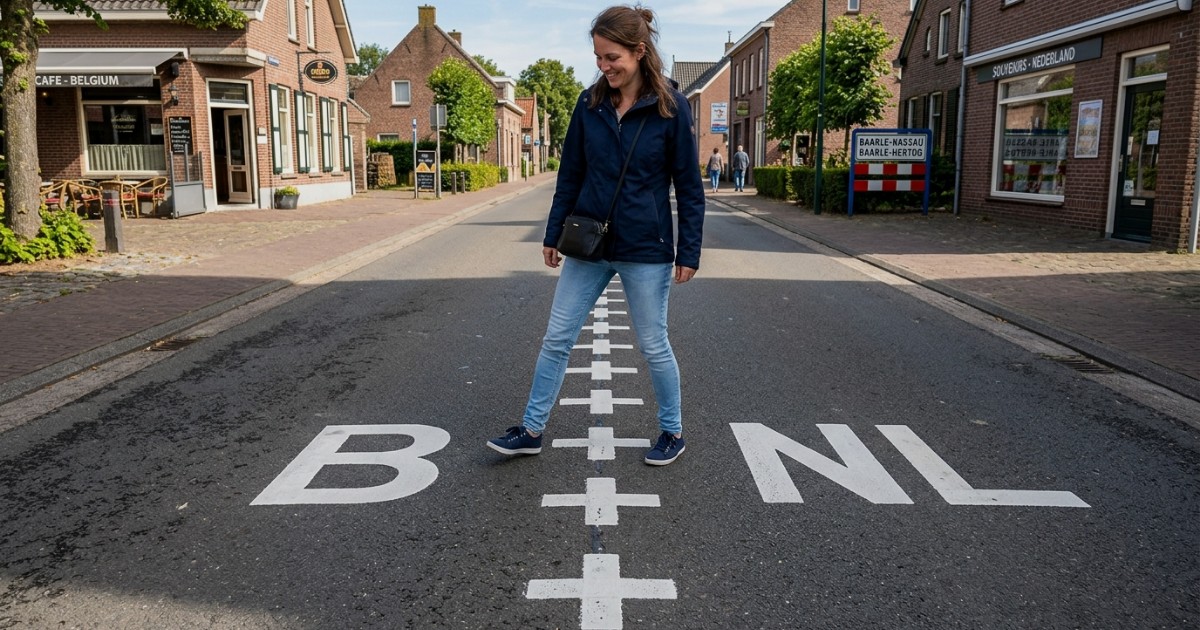
A quiet town situated along the southern boundary of the Netherlands showcases some of the most unusual border dynamics in global geography, where properties and businesses are physically sliced in half. In the cartographic anomaly known as Baarle, white cross markers painted explicitly on pavements divide local shops, cafes, and residential living rooms between two separate countries. The complicated arrangement leads to extraordinary domestic situations, such as married couples sleeping in the same bed but technically occupying separate sovereign nations. Miniature flags positioned above front doors serve as a continuous physical reminder of whether an individual is currently standing in Belgium or the Netherlands.
Local citizens have actively adapted to these political lines to maximize economic advantages for generations.
The patchwork quilt of enclaves dates back to the Middle Ages, when feudal aristocrats engaged in localized land swaps that were later finalized as national boundaries under the 1843 Treaty of Maastricht. Today, the 10,000 inhabitants of the town must continuously navigate two distinct legal, planning, taxation, and educational systems. Pockets of Belgian territory known as Baarle-Hertog remain scattered entirely within the Dutch municipality of Baarle-Nassau, creating a nested layout resembling Russian dolls. This territorial complexity generated significant policing difficulties throughout history, turning local enforcement efforts into a matter of regional folklore.
Willem van Gool, head of the local tourism office, noted that cross-border smuggling remained a systemic economic challenge for centuries. Local farmers regularly moved livestock across fields under the cover of darkness to secure higher prices while systematically evading domestic agricultural duties. During the 1960s, an enterprising resident went as far as constructing a financial institution directly atop a border line, shifting paperwork across tables to evade tax inspectors. Historical accounts also detail customs officials instructing suspected butter smugglers to stand near fires during documentation checks to melt out hidden contraband.
Modern Economic Arbitrage and Fuel Tourism
Following the implementation of the European Single Market in 1993, traditional customs checks disappeared, but residents discovered legal methods to exploit the persistent institutional variations. At De Biergrens, a large beverage retailer, a commercial border line is printed across the shop floor in national colors to delineate jurisdictions. If a commercial enterprise straddles the line, profits are taxed proportionally by both governments based on the exact square meters occupied on either side. Older residents observe that while historic commodity smuggling has declined, modern crowds visit primarily to exploit disparities in fuel prices.
Government price caps and lowered fuel duties within the Belgian jurisdiction make petrol roughly €0.5 cheaper per liter than on the Dutch side of the street. This significant pricing difference allows motorists to save up to €30 per vehicular fill-up, driving intense localized demand. Because Belgian statutory frameworks allow individuals to legally stockpile up to 240 liters of fuel in portable jerrycans, external drivers frequently descend on local forecourts. The resulting influx of fuel tourists routinely blocks local arterial roads, transforming commercial parking lots into gridlocked zones.
The unique layout has transformed the municipality into a primary destination for global border enthusiasts who document their travels on digital networks like Reddit. The onset of the Covid pandemic in 2020 exposed severe administrative frictions due to contradictory national healthcare mandates. While Belgium enforced strict lockdown protocols during the initial wave, the Netherlands operated under a highly liberal localized framework, creating community tension. International media operations flocked to the region to document how the two town councils eventually instructed citizens to uniformly follow the stricter rules.
Administrative Duplicity of a Divided Community
The logistical difficulties of managing dual citizenships become intensely practical for families navigating everyday milestones. Local residents Thomas and Ruth work within the Netherlands but reside inside a Belgian pocket of the town, forcing them to file taxes across both state systems. Following the recent birth of their twins, the couple spent months reconciling contradictory bureaucratic systems to secure valid documentation. They had to obtain standard Dutch passports for the newborns before presenting the physical papers to Belgian municipal offices simply to verify their legal existence.
The governance framework involves two separate town halls, two independent police forces, and specialized joint committees overseeing communal infrastructure like water and electricity. Philip Loots, the mayor of Baarle-Hertog, explained that the national boundary runs diagonally through the main ceremonial room of the Belgian town hall. During marriage proceedings, participants must remain structurally anchored on the Belgian side of the floor line to prevent the ceremony from being voided under national law. For the 160 line houses bisected by the border, legal residency is dictated by the front door rule, which looks at which country the primary entrance opens into. When a 1995 commission discovered a boundary error that threatened to move an elderly woman`s home into Belgium, officials simply shifted her physical front door two feet to the left to preserve her established Dutch social security benefits.