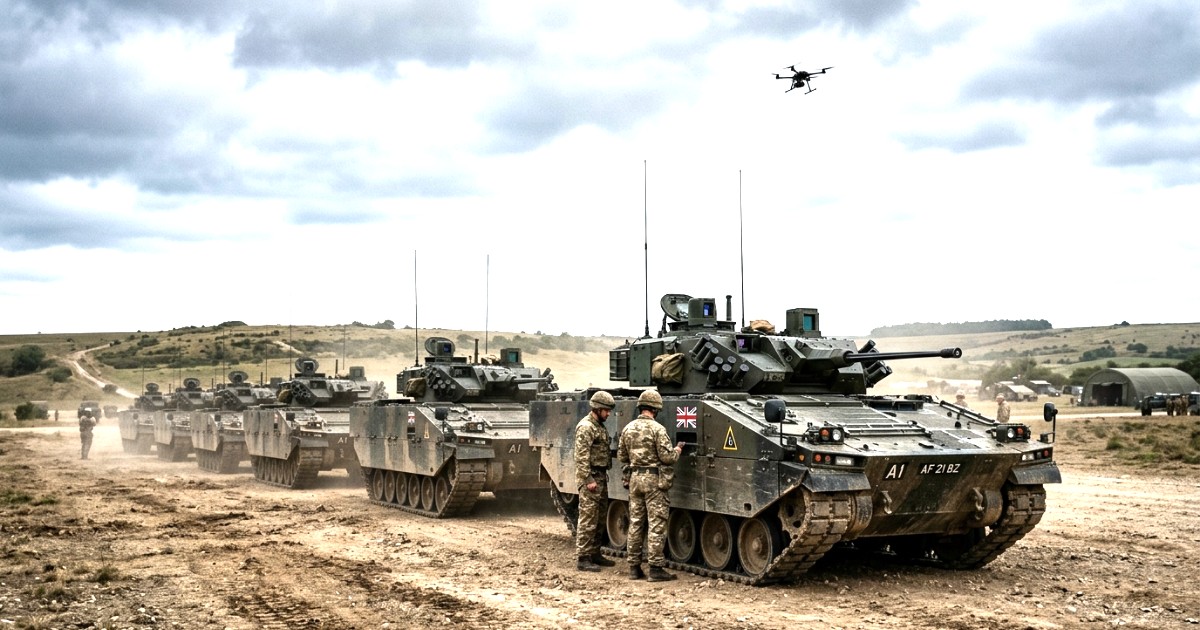
The British Army has officially shifted its structural approach to land warfare by embracing the revolutionary Recce-Strike doctrine outlined in the Ministry of Defence’s recent Strategic Defence Review. This adjustment represents the most critical conceptual transformation in British military thinking since the termination of the Cold War. The framework explicitly integrates the harsh operational realities of modern combat witnessed daily across Ukraine, where drone integration and rapid precision strikes dominate the battlespace.
Traditional armored platforms are no longer the exclusive arbiters of lethality.
The defense establishment estimates that future combat lethality will stem roughly 80 percent from uncrewed aerial systems and autonomous networks, leaving only 20 percent to conventional armored divisions and classic artillery. Ukrainian forces have mastered this asymmetrical integration despite acute ammunition deficits, staying significantly ahead of many NATO armies in tactical execution. This empirical evidence has forced British military strategists to drastically restructure their long-term defense expenditures and baseline battlefield doctrines.
The Three Pillars of Recce-Strike
The core concept of the British Army Recce-Strike doctrine integrates surveillance, tracking assets, and long-range precision fire into a singular digital ecosystem capable of neutralizing targets within minutes. The first operational pillar relies on artificial intelligence to accelerate the traditional kill chain by slashing the timeline between initial target identification and ultimate destruction. The second component involves persistent battlefield surveillance utilizing advanced sensor arrays and electronic warfare units. This environment is precisely where the long-debated Ajax reconnaissance vehicle becomes vital, transitioning from a basic vehicle into the digital nerve center of the frontline.
The third pillar focuses on long-range fires designed to disrupt enemy formations deep behind active conflict lines. To secure this capability, the government announced an approximately one-billion-pound contract to acquire 72 new self-propelled 155mm RCH 155 howitzers mounted directly on modern Boxer chassis. Manufactured domestically to preserve sovereign industrial resilience, this automated system can fire eight rounds per minute at targets up to 70 kilometers away. Simultaneously, the deployment of the Challenger 3 main battle tank will provide the division with its first fully digitized armored asset.
However, institutional implementation remains constrained by narrow timelines.
Geopolitical Volatility and Financial Realities
The current strategic timeline aims for full operational capability by the end of the decade, a pace that analysts suggest is dangerously slow given the velocity of global military innovation. Integrating disparate technical components like the Ajax, RCH 155, and Challenger 3 presents immense institutional challenges across logistics, personnel training, and field doctrine. Overcoming these operational bottlenecks requires the national treasury to deliver sustained funding alongside consistent political focus from Westminster leaders.
Domestic political shifts and changes in parliamentary control frequently place long-term defense spending at risk in favor of expanding domestic welfare budgets. This short-term calculation mirrors the post-Cold War peace dividend errors that systematically hollowed out much of the nation`s conventional military deterrence. With Russia maintaining its aggressive posturing, China growing assertive in East Asia, and Middle Eastern conflicts continuously destabilizing international trade routes, neglecting national security boundaries remains highly reckless.