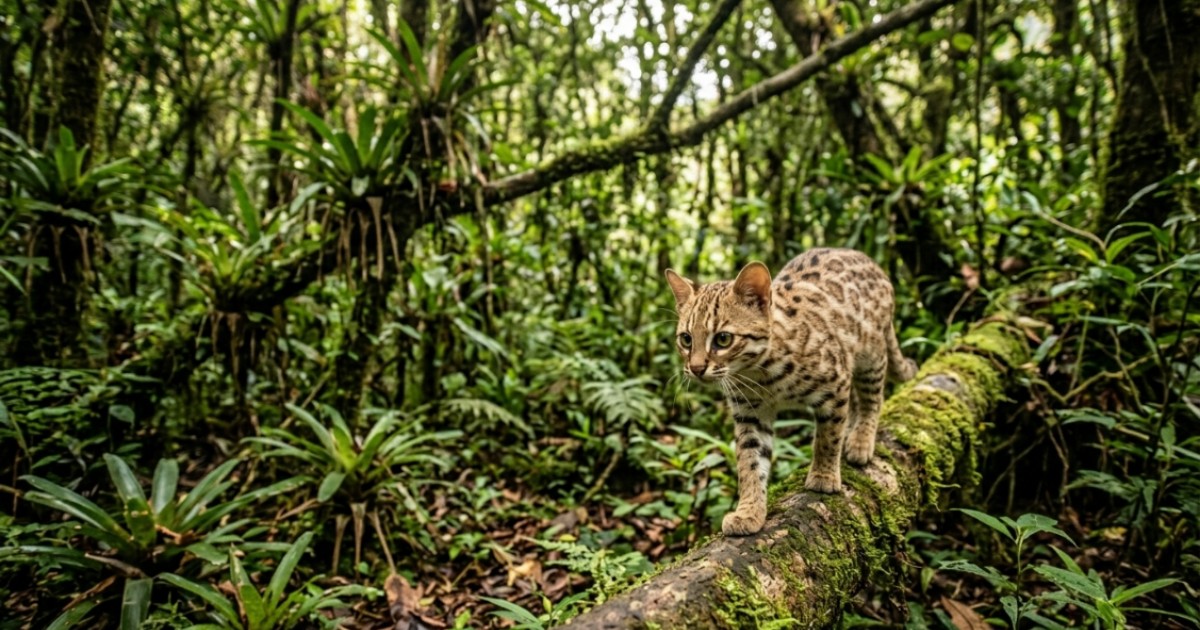
A diminutive wild cat native to the mist-shrouded cloud forests of Bolivia has been classified as an entirely distinct species, marking the first formal scientific description of a new living feline in more than a century, according to a research paper published Thursday in the journal Current Biology. Field researchers confirmed that the animal, known by Indigenous populations as the tilcayo, belongs to the tiger cat lineage distributed across South America. The discovery took place within the humid, high-altitude montane terrain of the Bolivian Yungas forest.
It represents the first living feline named in over a century.
Scientifically named Leopardus tilcayo, the predator measures approximately 46 centimeters in length and weighs roughly 1.4 kilograms, rendering it smaller than an ordinary domestic cat. Co-lead author and National Geographic Explorer Paola Nogales-Ascarrunz observed that the feline displays light brown fur patterned with irregularly shaped rosette markings across its torso. Scat samples recovered from the habitat revealed bone and fur fragments of tiny rodents, while remote camera-trap monitoring indicated that the creature conducts most of its hunting activities under cover of darkness.
Biologists had long struggled to distinguish the animal due to the cryptic nature of South American felines, whose external coats frequently mimic one another across regional populations. Evolutionary biologist Jonas Lescroart from the University of Antwerp explained that initial field interest arose when specimens in Bolivia failed to align with established morphology catalogs centered on Brazilian felines. To resolve the discrepancy, the international research team examined genomic DNA extracted from 38 wild cats across multiple nations, supplementing field samples with eight preserved museum specimens. The molecular sequencing revealed that South American tiger cats comprise five separate, genetically isolated evolutionary species rather than a single contiguous group.
The evolutionary analysis showed that the tilcayo branch diverged from related lineages approximately 1.4 million years ago, establishing an enduring genetic trajectory within the Andean foothills. Researchers noted that the animal had never previously been classified or proposed as an independent species by field zoologists. Concurrently, the team identified a distinct tiger cat subspecies inhabiting Peru`s Yungas montane belt, designating it Leopardus tigrinus antisuyo in homage to the Antisuyu territory of the historic Inca civilization.
The taxonomic confirmation underscores the critical biodiversity housed within South America`s endangered cloud forest belts. Wildlife authorities stressed that continued protection of the high-altitude Yungas ecosystem remains essential to securing the long-term survival of this ancient feline population.