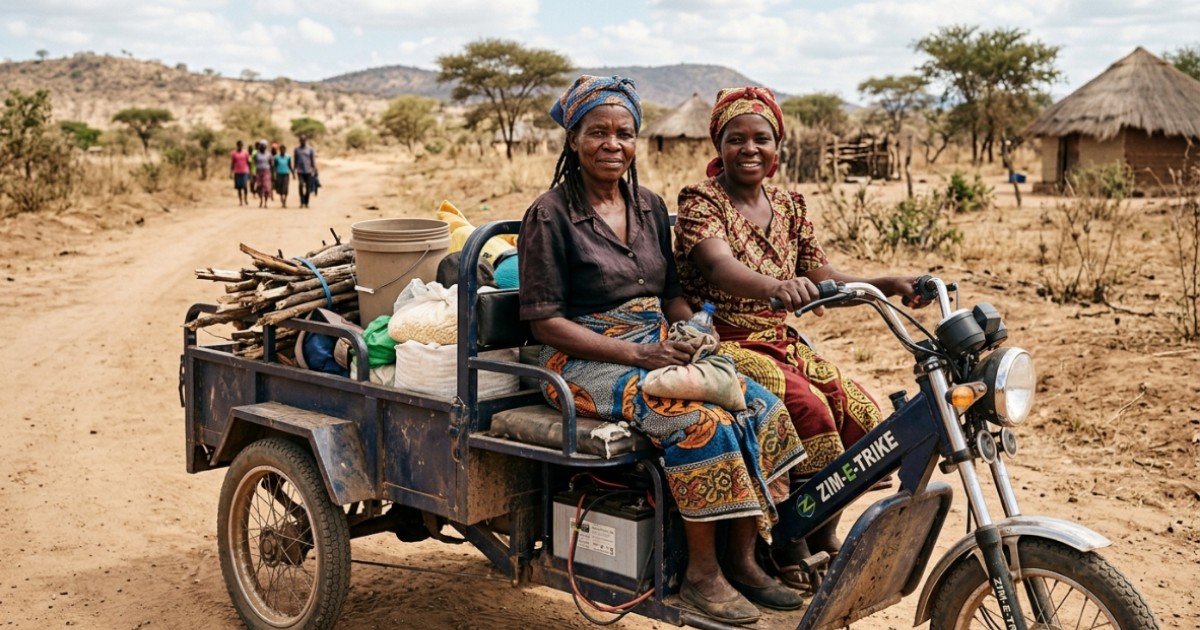
A sweeping police e-tricycle crackdown in Zimbabwe has severely disrupted the economic independence and fragile livelihoods of rural women in the country`s eastern region. Over the past few weeks, traffic law enforcement officials in Hauna and Chipinge have systematically impounded low-speed electric transport vehicles. This sudden enforcement push has left nearly 300 low-income operators, consisting mostly of single mothers and widows, facing deep financial uncertainty.Annual vehicle registration and operational licensing fees total nearly 500 dollars.
These exorbitant administrative costs remain completely out of reach for marginalized rural workers who rely on micro-revenues to survive. Powered by clean lithium battery packs, the eco-friendly transport trikes have a maximum operational speed capped at 25 kilometers per hour. Locally branded as the "Hamba"—a Shona term translating to "go"—these specialized electric vehicles were initially deployed to foster grass-roots structural empowerment. Each unit is capable of ferrying up to 450 kilograms of fresh produce, functioning as a logistical lifeline for regional farming communities.
Hauna smallholder operator Daires Mutamangira was actively transporting a local customer alongside basic household groceries along an unpaved village footpath when transit police abruptly detained her. The patrol officers strictly demanded to inspect official vehicle registration records and a heavy commercial driver`s license, which she could not provide. Despite her attempts to negotiate, officers summarily penalized her with an on-the-spot 15-dollar fine. Mutamangira expressed deep dismay over the enforcement, noting she never expected such severe structural crackdowns while operating far away from primary national highways.

The expanding sweep has effectively paralyzed micro-transport networks across Manicaland Province as police continue impounding specialized vehicles. National authorities still depend on colonial Rhodesian-era statutory frameworks to regulate modern automotive traffic across rural zones. These outdated traffic codes systematically classify low-speed electric utility vehicles under identical brackets as standard internal combustion engine motorcycles. Consequently, the law fails to distinguish between heavy commercial transit assets and small-scale green transport initiatives operated by rural women.Law enforcement agencies demand a steep 90-dollar fine to release any impounded vehicle.
Local startup "Mobility for Africa" originally launched the tech-driven project to alleviate severe transportation deficits in isolated agrarian sectors. Sikhangezile Dube, the startup`s operational site coordinator in Hauna, stated that management aggressively engaged state departments to resolve the regulatory logjam but was instructed to strictly comply with historical codes. Although the organization submitted extensive documentation to the Central Vehicle Registry and revenue authorities last June, official processing remains entirely stalled. As a result, the entire female-led transport initiative has been forced to suspend operations indefinitely.
The sudden loss of daily operational revenues has left Mutamangira struggling to manage basic school tuition fees and baseline nutritional needs for her four children. Her family has been forced to reduce their dietary consumption from three stable meals down to a single meal per day. Furthermore, isolated communities regularly relied on these electric trikes as makeshift medical ambulances to transport pregnant women and critically ill patients to distant regional clinics. The ongoing enforcement sweep has severed this informal health transport network, endangering thousands of vulnerable rural lives.