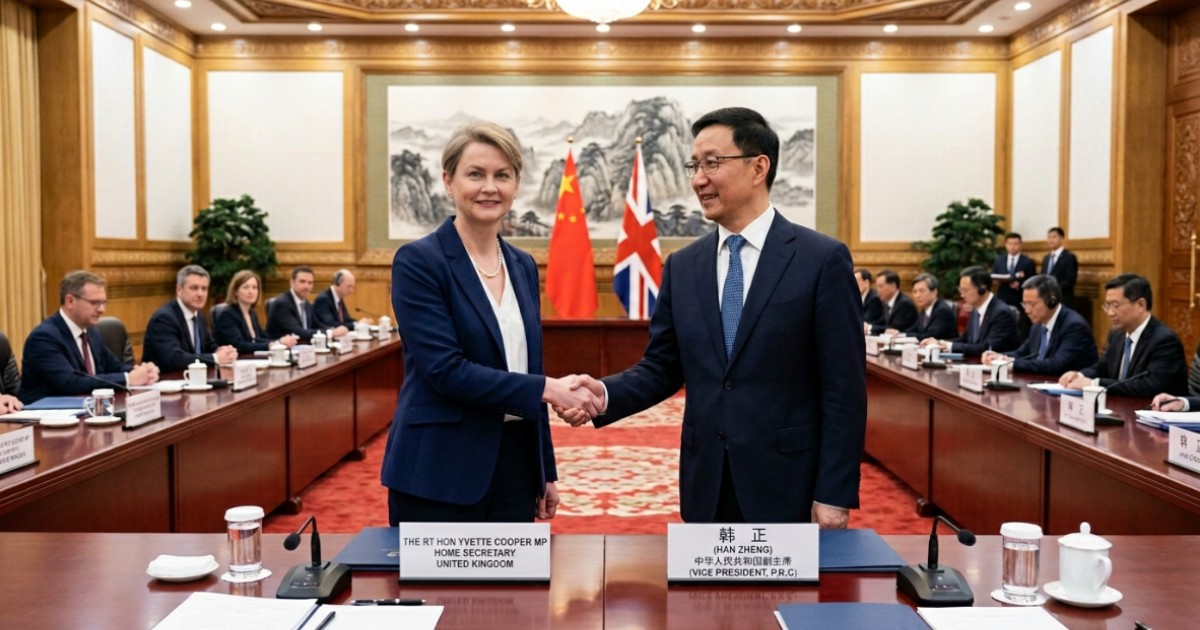
The United Kingdom and China are actively attempting to rebuild their diplomatic and economic ties following a prolonged period of frozen relations. British Foreign Secretary Yvette Cooper arrived in Beijing on Tuesday for a high-profile three-day official visit, signaling a pragmatic shift in London`s foreign policy. Meeting with Chinese Vice President Han Zheng at the Great Hall of the People, Cooper called for bilateral cooperation to address escalating global challenges, including the conflicts in Ukraine and Iran, alongside the Ebola outbreak in the Democratic Republic of the Congo.This diplomatic push represents a calculated effort to end what Downing Street describes as an ice age.
The groundwork for this reset was laid in January 2026 when British Prime Minister Keir Starmer travelled to Beijing to meet President Xi Jinping. Starmer`s winter visit yielded significant economic breakthroughs, including a $15 billion investment in China by British pharmaceutical giant AstraZeneca and expanded visa-free travel privileges for British citizens. Cooper`s subsequent trip marks the first back-to-back visits by a British prime minister and foreign secretary since former Prime Minister Theresa May and Jeremy Hunt made similar journeys in 2018. While acknowledging persistent areas of disagreement over human rights and national security, Cooper maintained that engaging with candor and respect would yield meaningful progress for both nations.
Geopolitical analysts indicate that growing economic necessities are driving Western powers back to Beijing despite heightened geopolitical instability. Western economies remain deeply dependent on Chinese manufacturing for advanced goods such as semiconductors, medical instruments, and aerospace components. Furthermore, China holds a strategic stranglehold on critical rare-earth elements vital for modern technological manufacturing. In the green energy sector, China continues to outpace Western nations in production and innovation, leading to a clean energy partnership signed last year between London and Beijing, which included a joint venture between Octopus Energy and China`s PCG Power.
The diplomatic realignment is also accelerated by shifting dynamics in Washington under US President Donald Trump. Tensions between the United States and the United Kingdom have heightened recently due to Prime Minister Starmer`s reluctance to provide naval backup in the US-Israel conflict with Iran or assist in opening the strategic Strait of Hormuz. Trump`s unpredictable foreign policy, paired with global energy shocks and sluggish British economic growth, has forced the United Kingdom to reinforce its own bilateral economic stability.
International relations experts from the London School of Economics note that the British economy uniquely complements China rather than competing directly. Unlike manufacturing-heavy economies like Germany, the United Kingdom specializes in high-value financial and professional services where China remains relatively weak. This foundational compatibility allows both countries to pursue mutual economic growth despite persistent ideological friction. Cooper is scheduled to conclude her trip in the technological hub of Shenzhen, where discussions will focus on trade and the future governance of artificial intelligence.