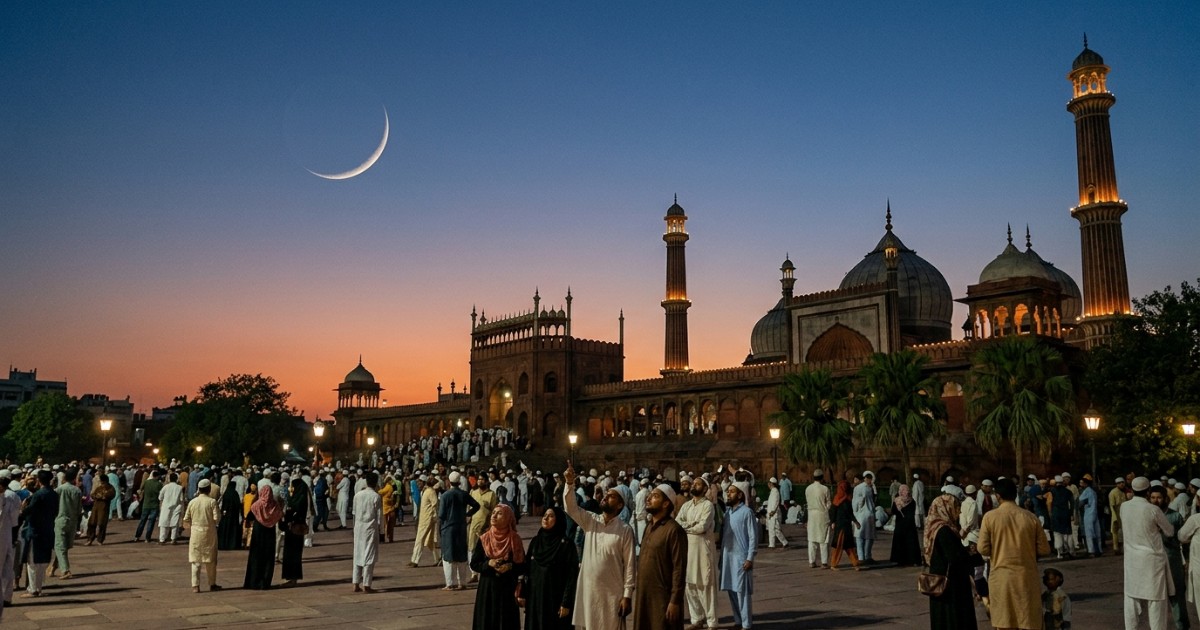
According to Islamic Shariah protocols, the formal scheduling of Eid al-Adha is strictly determined by the physical sighting of the new Dhul Hijjah crescent moon. Because of variations in global geographic positioning and longitudinal axes, the lunar crescent does not become visible across all international territories on the identical night. This structural reality routinely creates discrepancies between distant continents, but a rare manifestation of this lunar variance has now emerged within the borders of South Asia.
The three neighboring nations will not celebrate the major festival simultaneously.
On Sunday, May 17, Pakistan’s central Ruet-e-Hilal Committee convened a critical tracking session in Karachi to evaluate incoming atmospheric testimonies. Presided over by Chairman Maulana Abdul Khabir Azad, the state assembly included senior technical consultants from the Pakistan Meteorological Department and the national space agency, SUPARCO. Following verification of the astronomical datasets, the council formally announced that the crescent moon had been verified, establishing May 27 as the official date for Eid al-Adha. This domestic declaration aligns Pakistan directly with the holiday schedules of Saudi Arabia, the United Arab Emirates, and the wider Middle East.
In stark contrast, tracking teams across India and Bangladesh failed to register any validated views of the new moon. The central Ruet-e-Hilal Committee in Delhi issued a statement confirming that due to the total absence of credible sightings, Dhul Hijjah tracking would officially commence on May 19, positioning Eid al-Adha on May 28. Similarly, the National Moon Sighting Committee in Dhaka is finalized to announce an identical timeline based on domestic visibility metrics. Consequently, both Bangladesh and India will observe the religious sacrifice exactly one day after their Pakistani neighbors despite sharing a contiguous landmass.
This regional scheduling divergence stems entirely from established meteorological and orbital mechanics.
In astronomical terms, the visibility of a nascent moon depends heavily on its localized age, western elongation, and exact duration above the horizon following sunset, an arc known scientifically as the visibility curve. While the moon`s position over Dhaka and Delhi remains too immature for naked-eye detection during twilight, the earth`s rotation shifts the crescent into a readable position by the time it transits over Pakistani airspace. Furthermore, Pakistan`s integration of modern space scientists into its religious councils allows for highly empirical data processing. Conversely, authorities in India and Bangladesh continue to prioritize traditional visual observation as their primary legal framework.
While historically rare, this structural scheduling split is not entirely unprecedented for the region. In past decades, isolated northwestern border provinces in Pakistan frequently celebrated independently alongside Saudi Arabia, but a unified national mandate matching the Middle East has not occurred in modern times. Specialized calculations indicate that these precise orbital variables intersect to create regional discrepancies approximately once every ten to fifteen years. Regardless of the slight calendar variation, the central spiritual themes of personal sacrifice and devotion remain completely unified across the global Muslim community.