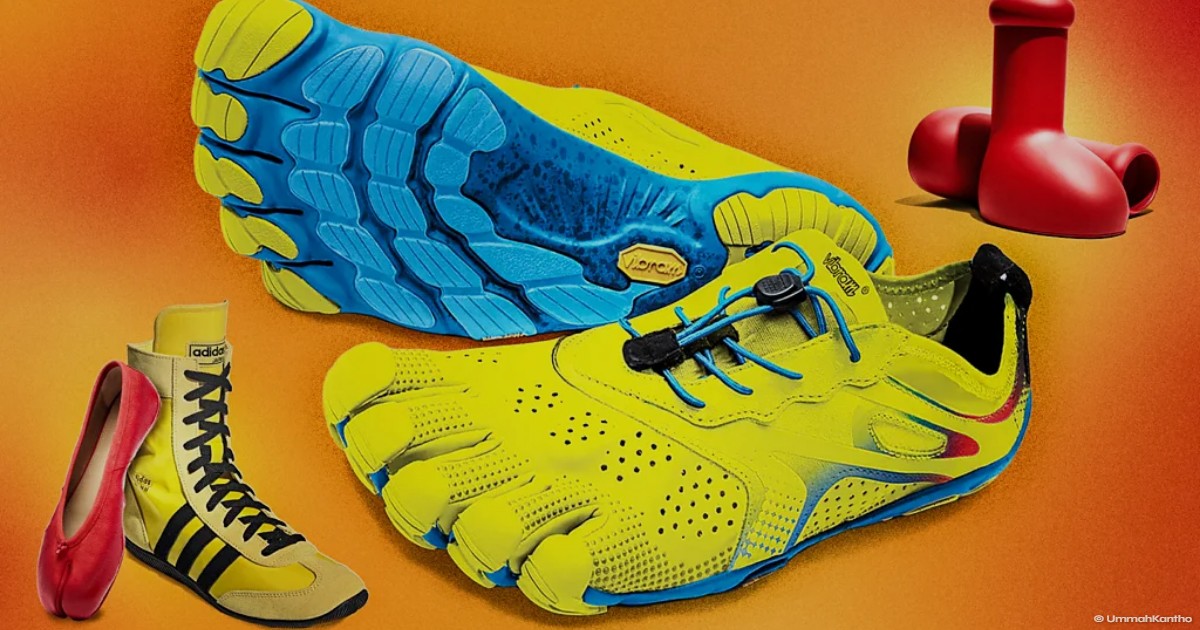
For some people, shoes are a mere afterthought—the more inconspicuous, the better. For others, footwear takes center stage as the main character of an entire outfit. But where a showstopping shoe might once have meant a sleek Manolo Blahnik stiletto, the fashion-forward crowd in 2026 is opting for something flat, wide, slightly bizarre, and perhaps looking not unlike a potato. In a word: awkward. Welcome to the era of the "ugly shoe," a trend that is taking the global style industry by storm by blending extreme practicality with high fashion.
These weird shoes laugh in the face of traditional elegance and "good taste" to offer something completely unexpected. Think of the five-toed sneakers that clothe toes like a glove, or mucus-colored Gardana gardening clogs that are currently seen on trendy feet from Brooklyn to Paris. Mutation and cross-breeding are officially "in," leading to the rise of the "Frankenshoe"—a hybrid of various silhouettes mashed into one. Among the most popular is the "snoafer" (a sneaker-loafer hybrid), which tech and style critics alike have coined the footwear equivalent of the spork.
Data Behind the Hype
While critics might find these designs laughably gross, real-life consumer demand is exceptionally high. This is no longer just editorial hype found on fashion runways; it has translated into massive commercial success. According to Brendan Dunne of the resale platform StockX, sales of Mary Jane-inspired sneakers were up more than 350 percent year-over-year in Q1 2026.
Furthermore, the most popular iteration of the snoafer, the New Balance 1906L, has registered more than 13,000 sales on StockX since its initial launch. There is immense consumer interest in hybrid silhouettes that blend sport, luxury fashion, and an element of unexpected, disruptive design.
J`Nae Phillips, creator of the Fashion Tingz newsletter, explained this phenomenon to the BBC:
"People increasingly enjoy fashion items that provoke reactions, become conversational objects, or function almost like visual memes."
The Anti-Perfection Movement
So, why are fashion lovers so intent on breaking out of the traditional shoe box? The answer lies in a psychological shift against the digital landscape. In an age dominated by "AI slop," perfectly curated Instagram feeds, and predictable corporate algorithms, these ugly shoes feel like a necessary juxtaposition to online perfection. They carry a distinct anti-perfection energy. At a moment when personal style feels increasingly performative, an unusual shoe signals individuality, humor, and a flat-out refusal to dress in a predictable way.
This shift is heavily supported by the "wrong-shoe theory," a styling trick introduced by Allison Bornstein that gained viral traction on TikTok. The theory posits that using footwear that slightly mismatches or looks a bit "off" is the absolute best way to inject personality into an outfit. A deliberately awkward shoe breaks the stiffness of a formal outfit, making the wearer look more self-aware and culturally fluent.
Additionally, there is an element of "If You Know You Know" (IYKYK) status signaling. Wearing split-toe or cloven-toe designs—originally popularized by Maison Margiela’s iconic Tabi shoes—serves as a quiet nod to high-fashion literacy, proving the wearer belongs to an elite subculture. As these strange variants become more widespread and co-opted by mainstream commercial brands, the fashion vanguard will likely push for even uglier variants to maintain their status. For now, the awkward, comfortable, and rebellious hybrid shoe reigns supreme in 2026.