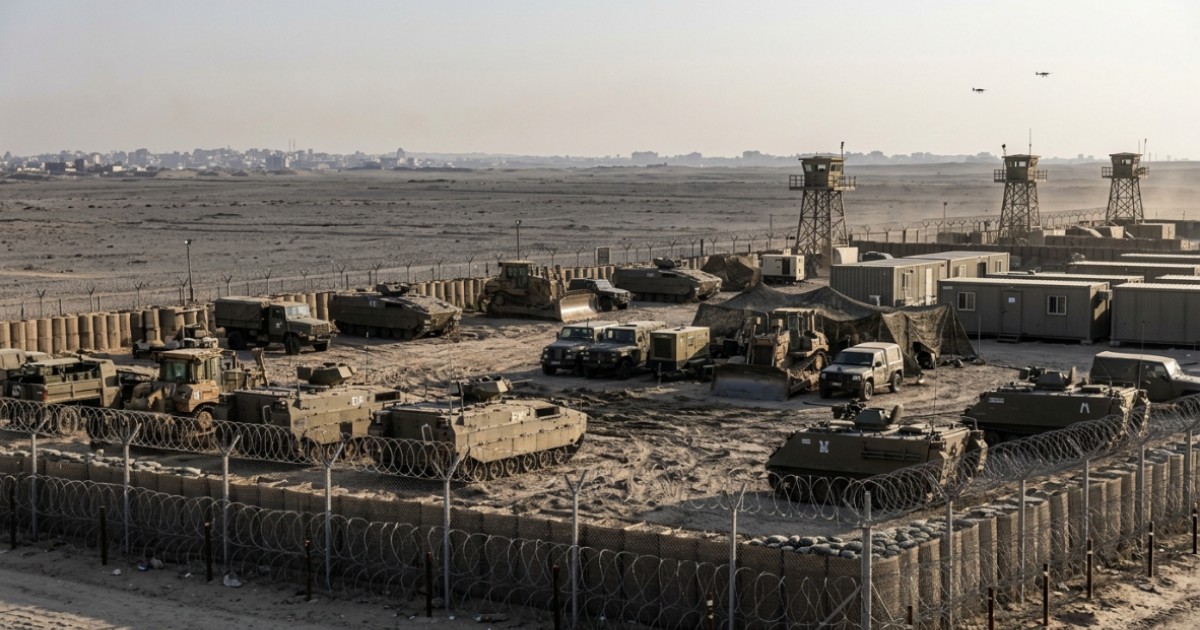
Israeli forces are quietly cementing permanent, heavily fortified military outposts across the besieged Gaza Strip instead of pulling back as mandated by international agreements. A detailed investigation analyzing satellite data up to May 2026 has exposed the rapid build-up of these structural fortifications inside the enclave. The tactical evidence indicates that Israel has established 40 distinct military outposts entrenched deeply within Palestinian territory.Crucially, eight of these operational bases were constructed entirely from scratch after the October 2025 truce took effect.
This aggressive physical entrenchment aligns with the increasingly overt territorial ambitions expressed by the state`s political leadership. Speaking at a recent conference, Prime Minister Benjamin Netanyahu confirmed administrative directives to permanently seize the vast majority of the Gaza Strip. Israeli forces have currently pulled back to the "Yellow Line," a strategic buffer zone that encompasses roughly 60 percent of the enclave`s total landmass. Netanyahu explicitly told the audience that the military is squeezing opposition forces, hinting at a progressive target to annex up to 70 percent of the territory over time.
The comprehensive satellite analysis exposes a systematic effort to deploy long-term military infrastructure rather than temporary observation decks. These highly fortified installations are strategically dispersed across the territory, including two in northern Gaza, two in the central region, one east of the Netzarim Corridor, and three in the southern city of Khan Younis. In a highly controversial spatial takeover, engineering teams established a new military base directly atop the bulldozed ruins of the Eastern Cemetery in Khan Younis. Aerial data confirms that landscaping and defensive modifications over the historic burial ground began in November 2025, transforming the plot into vehicle staging areas and troop housing units by mid-May 2026.
A corresponding pattern of rapid militarization is visibly documented on the outskirts of Beit Lahiya in northern Gaza. Areas that appeared entirely clear in late October 2025 suddenly showed the onset of heavy engineering works within weeks. This extensive base network underscores a structural shift toward prolonged occupation, rendering the previously negotiated diplomatic frameworks increasingly obsolete.